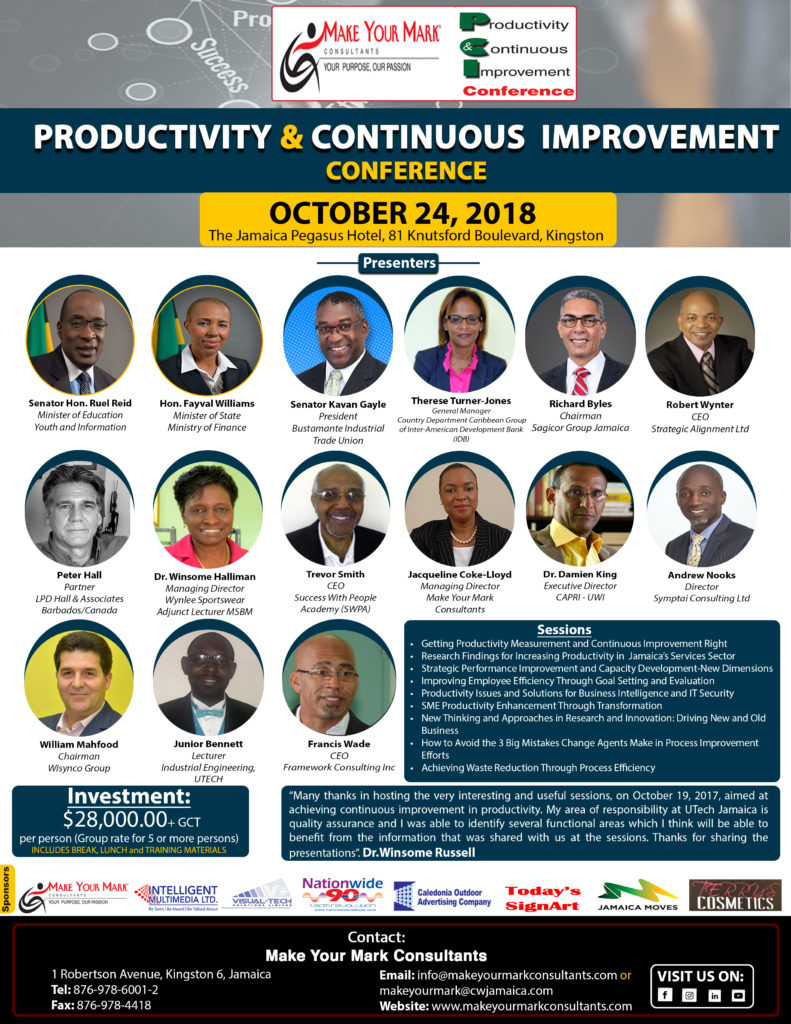
I just received some good news – I will be presenting at the ASTD Conference in Washington DC. Hope to see a great representation from the Caribbean and global productivity communities.

This is episode four, on Step Four of the Workflow Diagram / Map, Reflect (Review), in our nine-part series on the Getting Things Done (GTD) personal productivity methodology and eponymously-titled book, from the perspective of the ProductivityCast team–as long-term practitioners, critics and observers of GTD.
“[...O]ne of the requirements it that you have to come back and reflect and review on your system and care and feed it and make sure that it stays current."
"See a lot of the value of Getting Things Done methodology is being able to offload off your psyche the job of remembering and reminding. In order to do that though, you can’t fool your own mind. It knows whether or not you’ve looked at what you need to look at as often as you need to look at it and if you’re not doing that, that’s not just the weekly review, but if you’re not looking daily at your calendar and you know you need to, then some part of you is gonna be bothered by that all the time."
~David Allen (Source)
In this cast, we cover the concept of Reflect (formerly Review) on your system on a frequency and in methods that work for you, so that you can iterate on your productivity and make strategic next action decisions as your life and work circumstances change.
(If you’re reading this in a podcast directory/app, please visit http://productivitycast.net/042 for clickable links and the full show notes and transcript of this cast.)
Enjoy! Give us feedback! And, thanks for listening!
If you'd like to discuss this episode, please click here to leave a comment down below (this jumps you to the bottom of the post).
In this Cast | Reflect - Getting Things Done (GTD)
Ray Sidney-Smith
Francis Wade
Art Gelwicks
Show Notes | Reflect - Getting Things Done (GTD)
Resources we mention, including links to them will be provided here. Please listen to the episode for context.
Getting Things Done: The Art of Stress-Free Productivity by David Allen
Making It All Work: Winning at the Game of Work and the Business of Life by David Allen
18 Minutes: Find Your Focus, Master Distraction, and Get the Right Things Done by Peter Bregman
Better Than Before by Gretchen Rubin
Four Tendencies by Gretchen Rubin
Evernote
OneNote
Journey
Day One
IFTTT
Raw Text Transcript | Reflect - Getting Things Done (GTD)
Raw, unedited and machine-produced text transcript so there may be substantial errors, but you can search for specific points in the episode to jump to, or to reference back to at a later date and time, by keywords or key phrases. The time coding is mm:ss (e.g., 0:04 starts at 4 seconds into the cast’s audio).
Read More
Voiceover Artist 0:00
Are you ready to manage your work and personal world better to live a fulfilling, productive life? Then you've come to the right place. Productivity cast, the weekly show about all things productivity here. Your hosts Ray Sidney-Smith and Augusto Pinaud with Francis Wade and Art Gelwicks.
Raymond Sidney-Smith 0:17
Welcome everybody to productivity cast the weekly show about all things productivity. I'm recently Smith, and I'm joined here this morning with Francis Wade and Art Gelwicks. Good morning gentlemen,
Francis Wade 0:27
morning.
Raymond Sidney-Smith 0:28
Good day, good day to you all. And Good day, to our listeners, wherever you might be listening from today, we are going to be talking about getting things done. This has been in a series of episodes where we've been discussing getting things done the art of stress, free productivity by David Allen, and really having a conversation around each of the fundamental components of the GTD methodology. And so we are going to be talking about reviewing and reflecting. So in the first edition of getting things done back in 2001, David Allen called this stage reviewing. And I think it created a number of different confusions for people. And in the march 2015 edition, actually, subsequent in the 2011, making it all workbook,
In our work we have discovered that managers have a challenge learning strategic planning skills. Here are the ones they need to focus on learning as early as possible – long before they are promoted.
Listen to the podcast here.
Host’s note: You will notice that Art Gelwicks stopped speaking about 13 minutes into this week’s ProductivityCast about the GTD step, Organize. Unfortunately, there were technical difficulties. Our apologies for any parts where it may sound like we jumped from segment to another; it’s likely where Art was speaking and his audio wasn’t available.
That said, this is episode three, on Step Three of the Workflow Diagram / Map, Organize, in our nine-part series on the Getting Things Done (GTD) personal productivity methodology and eponymously-titled book, from the perspective of the ProductivityCast team–as long-term practitioners, critics and observers of GTD.
“Being organized simply means that where something is matches what it means to you. No more, no less.” ~David Allen
In this cast, we cover how and where to organize after clarifying items in our inboxes, so that we can effectively trigger next actions when we have discretionary time to make progress on our projects and tasks.
(If you’re reading this in a podcast directory/app, please visit http://productivitycast.net/041 for clickable links and the full show notes and transcript of this cast.)
Enjoy! Give us feedback! And, thanks for listening!
If you'd like to discuss this episode, please click here to leave a comment down below (this jumps you to the bottom of the post).
In this Cast | Organize - Getting Things Done (GTD)
Ray Sidney-Smith
Augusto Pinaud
Art Gelwicks
Show Notes | Organize - Getting Things Done (GTD)
Resources we mention, including links to them will be provided here. Please listen to the episode for context.
Getting Things Done: The Art of Stress-Free Productivity by David Allen
The Happiness Advantage: How a Positive Brain Fuels Success in Work and Life by Shawn Achor
“Getting Things Done: The Science behind Stress-Free Productivity” (p. 5 flowchart with processing/organizing questions)
Evernote
Remember the Milk
Google Calendar
Mind42
Simple Mind
FreeMind
Tony Buzan
Goodnotes 4 (iOS)
Raw Text Transcript | Organize - Getting Things Done (GTD)
Raw, unedited and machine-produced text transcript so there may be substantial errors, but you can search for specific points in the episode to jump to, or to reference back to at a later date and time, by keywords or key phrases. The time coding is mm:ss (e.g., 0:04 starts at 4 seconds into the cast’s audio).
Read More
Voiceover Artist 0:00
Are you ready to manage your work and personal world better to live a fulfilling productive life? Then you've come to the right place productivity cast the weekly show about all things productivity here your hosts, Ray Sidney-Smith and Augusto Pinaud with Francis Wade and Art Gelwicks.
Raymond Sidney-Smith 0:17
Welcome everybody to productivity cast the weekly show about all things personal productivity. I'm recently Smith and I'm joined with my co host goes to pronounce. How's it going to gusto.
Augusto Pinaud 0:26
It's going to. Well, good morning.
Raymond Sidney-Smith 0:28
Hello. Hello. And we have art galleries with us today. How's it going art
Art Gelwicks 0:32
doing pretty well, so far? Guys?
Raymond Sidney-Smith 0:33
How about you guys? I am doing well. I glad to hear you're doing well. And we're going to hope that our listeners are doing well. And in this cast, we are going to talk about organizing, and we're going to be talking about it in the GTD flavor getting things done by David Allen flavor in this series that we've been ongoing. And we're going to talk about the idea of what is organizing? How do we define organizing, at least in the context of getting things done? Well, then talk about how each of us organizes our projects, next actions and other items, whether that be in a traditional list or otherwise. And then we're going to talk about some of the challenges that we know people face in getting organized in GTD and then maybe how to overcome them, or at least commiserating with you about the travails of getti...
The original article was published here.
What should executives do about their strategy execution problems? Here’s a simple idea: schedule time to execute strategy with Meetingless Meetings.
Listen to the podcast here.
On November 28-30, the Caribbean Tourism Organization will be holding a conference in Cayman. I’ll be one of the speakers.
For more advanced information, see this link.
This is episode two, on Step Two of the Workflow Diagram / Map, Clarify (formerly Process), in our nine-part series on the Getting Things Done (GTD) personal productivity methodology and eponymously-titled book, from the perspective of the ProductivityCast team--as long-term practitioners, critics and observers of GTD.
“Without a next action, there remains a potentially infinite gap between current reality and what you need to do.” ~David Allen
In this episode, we discuss how we all define Clarify and how we process/clarify in our own systems today, as well as what challenges we see GTD practitioners face and how to overcome those issues in day-to-day productivity.
(If you’re reading this in a podcast directory/app, please visit http://productivitycast.net/040 for clickable links and the full show notes and transcript of this cast.)
Enjoy! Give us feedback! And, thanks for listening!
If you'd like to discuss this episode, please click here to leave a comment down below (this jumps you to the bottom of the post).
In this Cast
Ray Sidney-Smith
Augusto Pinaud
Francis Wade
Art Gelwicks
Show Notes
Resources we mention, including links to them will be provided here. Please listen to the episode for context.
Evernote
Toggl
Raw Text Transcript
Raw, unedited and machine-produced text transcript so there may be substantial errors, but you can search for specific points in the episode to jump to, or to reference back to at a later date and time, by keywords or key phrases. The time coding is mm:ss (e.g., 0:04 starts at 4 seconds into the cast’s audio).
Read More
Voiceover Artist 0:00
Are you ready to manage your work and personal world better to live a fulfilling productive life? Then you've come to the right place productivity cast the weekly show about all things productivity here your hosts, Ray Sidney-Smith and Augusto Pinaud with Francis Wade and Art Gelwicks
Raymond Sidney-Smith 0:19
Welcome back everybody to productivity cast the weekly show about all things personal productivity I'm recently Smith i'm joined with my co host Augusto Pinaud. How's it going? Good morning, Francis Wade and Art Gelwicks. How are you gentlemen? Great. I'm doing well, we are going to be talking about the second stage of the workflow diagram within getting things done by David Allen. And this is the stage that he calls processing and the first edition or clarifying in the second edition. And so for the rest of our discussion today, just know that we may note processing or clarifying as, as the terms sort of equally, okay, so I wanted to start off the discussion with how each of us defines the term processing or clarifying in the context of GTD, what we remember, say, from what David Allen told us, it was in in our readings of the book, and how we determine or define that in our practices today, and our productivity systems today, because they obviously change over time, I don't think that the term processor clarify is immutable, just because over time, the way in which we do it is so fundamentally different, because if we do it, and we do it well, long enough, it changes, we become better at it. And therefore processing clarifying becomes a different process for each of us. And so I'm open to discussion on that as well. But let's start off with defining processing or clarifying,
Augusto Pinaud 1:45
you know, as I said, you know, that collecting assumption that for me was Oh, super clear, super cool. The processing part to me a lot longer to understand, okay, now, I have old days what I'm going to do, and to really slow down enough so I could really process this stuff, you know, the beginning was like, Okay, well, I get this envelope with papers of new car. Okay, then file and I, my default answer was, when in doubt, file,
what produce in many cases was a ridiculous big file cabinet.
And me going back to all I forgot to register the car. So good. I knew now where the papers were,
Over the next nine episodes, we are going to be in conversation about Getting Things Done: The Art of Stress-Free Productivity by David Allen. We are going to talk about each of the steps in the GTD Workflow Diagram / Map. We will cover capturing, clarifying, organizing, reflecting and engaging, then a discussion about Weekly Review. Finally, we will cover what we wish we knew when we started our GTD practices many years ago.
In this first cast in this series, we discuss GTD's first step in the Workflow Diagram / Map, Capture. Capture is more than simply writing things down. GTD gives us a cohesive method for getting all of our incompletes and commitments into places where you know you'll look at it again.
(If you’re reading this in a podcast directory/app, please visit http://productivitycast.net/039 for clickable links and the full show notes and transcript of this cast.)
Enjoy! Give us feedback! And, thanks for listening!
If you'd like to discuss this episode, please click here to leave a comment down below (this jumps you to the bottom of the post).
In this Cast
Ray Sidney-Smith
Augusto Pinaud
Francis Wade
Art Gelwicks
Show Notes
Resources we mention, including links to them will be provided here. Please listen to the episode for context.
Getting Things Done Virtual Study Group (live call-in discussion and podcast)
Getting Things Done by David Allen
Perfect Time-Based Productivity (2nd Edition) by Francis Wade
Google Keep
OmniFocus
Amazon Echo Devices (voice-based assistant)
Remember the Milk
Evernote
Livescribe smartpen and notebooks
Everlast reusable notebooks (not the Wave Rocketbooks - do not microwave these!)
Amazon Kindle
How to Escape the Zeigarnik Effect
Francis has a self-assessment for Capturing Skills: https://www.proprofs.com/quiz-school/story.php?title=how-good-are-you-at-capturing
Raw Text Transcript
Raw, unedited and machine-produced text transcript so there may be substantial errors, but you can search for specific points in the episode to jump to, or to reference back to at a later date and time, by keywords or key phrases. The time coding is mm:ss (e.g., 0:04 starts at 4 seconds into the cast’s audio).
Read More
Voiceover Artist 0:00
Are you ready to manage your work and personal world better to live a fulfilling, productive life? Then you've come to the right place productivity cast, the weekly show about all things productivity here, your host Ray Sidney-Smith and Augusto Pinaud with Francis Wade and Art Gelwicks.
Raymond Sidney-Smith 0:17
Welcome back everybody to ProductivityCast the weekly show about all things personal productivity. This is Episode 039 Episode 39 of ProductivityCast. And today I am joined by Augusto Pinaud, Francis Wade and Art Gelwicks. Welcome to the show, Gentlemen.
Unknown 0:35
Good morning. Great to be here.
Raymond Sidney-Smith 0:38
Good morning, everybody. Over the next nine episodes, we are going to be in conversation about getting things done the art of stress free productivity by David Allen. We're going to talk about each of the nine steps in the GTD workflow diagram slash map. And we will cover capturing, clarifying, organizing, reflecting and engaging and then have a discussion about the weekly review. Finally, we will cover what we wish we knew when we started our GTD practices many years ago. In the final two episodes, I think it'll be really interesting for us all to kind of look at this from the different perspectives we have on getting things done. Some of us are GTD practitioners, some of us are not some of us have been critics of some of these parts of the book. And some of us have been great advocates and enthusiasts for it. So I think it'll be really interesting for us to be able to have a conversation about each of these pieces. And Up first is the concept of collecting and or capturing David Allen started by calling it collecting and the collection habit, as he used to call it,