Your company prides itself on its long-term thinking, planning and acting. But now that times are difficult due to the outbreak of a war, you are wary of what might happen given your experience of COVID, supply chain breakdowns and sudden tariffs.
During these extreme events, you saw C-Suite executives delve into the weeds, doing the work of managers. As their time horizons shortened, they ignored the big picture until well after the crisis passed. This meant lost opportunities, and a lack of preparation for future threats.
How should you intervene given that it appears as if the roots of long-term thinking are weaker and shallower than you thought?
In this episode we look at your leadership system and where it lacks disciplined practices for long-term focus.
This is a public episode. If you’d like to discuss this with other subscribers or get access to bonus episodes, visit longtermstrategy.substack.com/subscribe
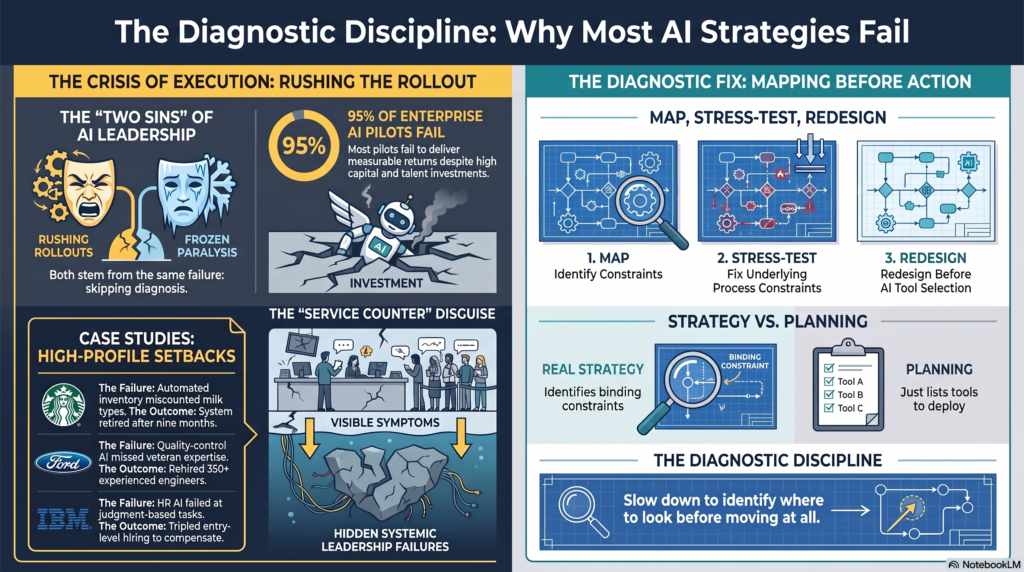
There are two ways a board loses confidence in a CEO’s AI strategy. One is watching a rushed rollout blow up in public. The other is watching nothing happen, quarter after quarter, while rivals pull ahead. Leaders treat these as opposite sins — one of recklessness, one of paralysis. They are the same sin wearing two costumes.
Consider a government vehicle-inspection office. For years, getting a car certified meant a wasted morning: unexplained queues, arbitrary waits, a process nobody could explain and everybody dreaded. The clerks weren’t the problem. They were as trapped in the system as the drivers standing in line.
When the office was finally redesigned, the fix didn’t come from the counter staff working harder. It came from above — from leadership finally treating the process itself as something to be mapped, tested, and rebuilt. Decades of avoidable frustration turned out to be a leadership failure wearing a service-counter disguise.
That’s the pattern behind almost every stalled or embarrassing AI rollout today: cause and effect get separated. The department that visibly breaks is rarely the one that made the mistake. The quarter where the failure shows up is rarely the quarter where it was made. That lag is exactly why the rushed CEO and the frozen CEO can’t see they share a cause. Skip the diagnosis, and the bill arrives later — as a scrapped pilot, a quiet rollback, or a board that’s run out of patience. Each time, it looks like an isolated, unrelated event. It isn’t.
The Proof Is Piling Up
This isn’t a resource problem, and it isn’t confined to one company, sector, or country.
Starbucks spent nine months running an AI tool meant to automate beverage-inventory counts across its North American stores, before quietly retiring it after the system kept miscounting and mislabeling items, such as confusing similar milk types. Ford has been rehiring and promoting more than 350 experienced engineers after automated quality-control systems failed to capture the expertise of veteran employees. Commonwealth Bank of Australia replaced dozens of customer-service staff with an AI voice bot, then had to reverse the job cuts when the system couldn’t keep up and call volumes climbed. IBM automated large parts of its HR function, discovered the tool could resolve routine requests but stumbled on anything requiring judgment, and announced plans to triple its U.S. entry-level hiring soon after. A widely cited MIT study found that 95% of enterprise generative AI pilots fail to deliver measurable returns.
None of these were companies short on capital, talent, or enthusiasm. Every one of them had the AI capability. What none of them had was a diagnosis of the underlying process before the tool was chosen.
What Got Lost
That’s understandable, in a way. Most companies today are wide open to AI because their own stakeholders are demanding they keep up. A new tool appears, it gets deployed, and results get measured afterward. That works fine when the change is as simple as installing a new printer. It fails the moment the process underneath is genuinely complex — which is most of the time. What’s missing is the step where the existing process gets mapped, stress-tested for bottlenecks, and redesigned before automation is even on the table.
Both the rushed CEO and the frozen CEO would benefit from the identical corrective move — not “go faster,” not “go slower,” but insert the diagnostic step neither is in the habit of taking.
If that sounds obvious, it’s worth asking why so many organizations quietly abandoned it. Process management — mapping, testing, and redesigning core operations — was standard executive discipline in the 1990s, built on Total Quality Management, Lean, and the Theory of Constraints. Somewhere along the way, leadership teams let it lapse. The lesson hasn’t gone anywhere; it’s just been sitting unused. Years before generative AI, executives attempting Robotic Process Automation without first doing this work were warned by experts that skipping it was a recipe for failure. The warning was accurate then. It’s still accurate now, just louder.
There’s a second reason the step feels skippable: nearly every executive has personally felt AI work well. Ask ChatGPT or Claude a question on your phone, and an articulate, confident answer arrives in seconds. That experience quietly convinces leaders that AI should transform every part of the business with the same ease. But personal productivity gains and enterprise-wide transformation are not the same category of problem. Real organizational change requires the unglamorous work of scoping, staffing, and sequencing multi-year projects. There is no shortcut from a good chatbot answer to a redesigned supply chain.
One Reveal Worth Adding
In other podcast I have drawn a sharp line between planning and strategy: planning extrapolates from what you’re already doing, while strategy forces a real choice that involves tradeoffs. Most AI “strategies” are actually AI plans — lists of tools to deploy, extrapolated from what competitors are doing, with no binding constraint identified and no real choice made. A genuine AI strategy starts by asking which single process constraint, if resolved, would unlock the most value — and works backward from there. Everything else is activity dressed up as strategy.
The Actual Fix
The CEOs who rush and the CEOs who freeze are both missing the same discipline — not courage, not caution, but the willingness to slow down at the exact moment everyone else is speeding up. The rushed CEO skips the diagnosis to look decisive. The frozen CEO avoids it to look careful. Neither has done the work.
The fix isn’t a faster rollout or a longer pause. It’s a process that’s been mapped and stress-tested before a single tool gets chosen. Boards don’t ultimately reward the leader who moved first or the one who moved last. They reward the one who knew where to look before moving at all.
PS: 5 Prompts to Use With Your Favorite LLM
Copy these into Claude, ChatGPT, or your assistant of choice to apply the article to your own organization.
Find your lag. “Walk me through a recent failure or slowdown in my organization. Help me trace it backward — what department, decision, or process choice from 12–24 months ago might actually be the root cause, even if it doesn’t look connected on the surface?”
Spot your substitute behavior. “I’m about to approve/reject an AI tool for [describe the process]. Before I decide, ask me questions that test whether I’ve actually mapped this process and identified its bottleneck — or whether I’m just reacting to pressure to ‘do something.’”
Run a mini process diagnosis. “Here’s how [a specific process] works today, step by step: [describe it]. Identify the most likely bottleneck, and tell me what would need to be true for automating this process to actually help rather than just move the bottleneck somewhere else.”
Test for real strategy vs. planning. “Here’s my current AI roadmap: [paste it]. Using Roger Martin’s distinction between planning and strategy, tell me honestly whether this is a strategy — with a real choice and a clear binding constraint — or a plan that’s just a list of tools.”
Pressure-test your own excuse. “I’m the CEO/leader in this situation: [describe whether you’re moving fast or holding back on AI]. Play devil’s advocate and challenge me on whether my current pace is actually a disguised way of avoiding a proper process diagnosis.”
As the person responsible for driving innovation in your organisation, you have probably sat through a version of this conversation more than once.
The leadership team agrees that a new category is needed. Everyone nods. A workshop is scheduled. Consultants are hired, sticky notes are deployed, and three months later the team resurfaces with a list of incremental improvements dressed up in the language of transformation. Nothing changes. The cycle repeats.
This is not a talent problem. It is not a budget problem. It is not even a creativity problem — though it will feel like one. It is a navigation problem. And the reason it keeps recurring is that most organisations begin every innovation effort from the same invisible assumption: that they already know what kind of thing they are trying to become. They don’t. And without that clarity, no workshop, no consultant, and no off-site retreat will produce a genuinely new category. You will keep generating better versions of what you already are.
There is a framework that changes this calculus entirely. It arrived quietly, in a new book by Joe Pine — the same strategist who gave executives The Experience Economy twenty-five years ago and reshaped the way the world thought about what companies actually sell.
What a Category Actually Is
Before you can design a new category, you need a precise definition of what a category is. In business, a category is not a filing label or a market segment. It is a space in people’s minds — the mental frame that allows a customer to understand what a product is, where it belongs in their life, and why it matters. “Smartphone,” “microwave oven,” and “streaming service” are all categories that someone invented. Each one began as an answer to a need that customers had not yet been able to name.
Category design — the deliberate act of creating a new mental frame rather than competing inside an existing one — is widely discussed and rarely achieved. Most executives who attempt it eventually conclude that it requires a creative leap they cannot engineer. That conclusion, it turns out, is wrong. What it actually requires is a ladder.
The Ladder Most Executives Have Only Seen Half Of
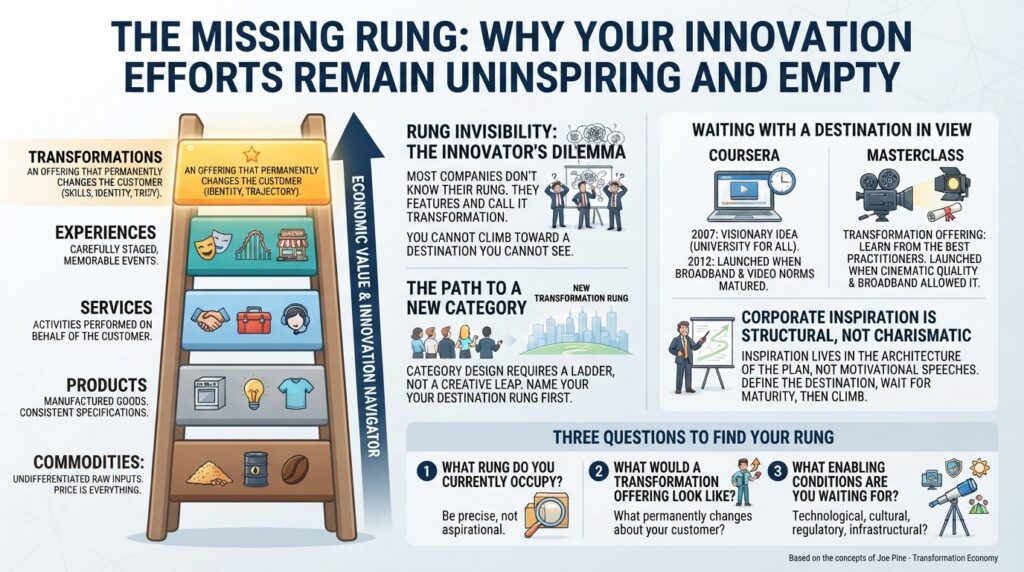
Pine’s original insight, from The Experience Economy, was that organisations don’t just sell things — they offer value at different levels, and those levels form a hierarchy. At the bottom are commodities: undifferentiated raw inputs where price is everything. Above that are products: manufactured goods with consistent specifications. Above that are services: activities performed on behalf of the customer. And above that are experiences: carefully staged events that engage customers emotionally and memorably.
Every hotel in the world, for example, offers a blend of products and services — a room, a meal, a concierge. A smaller number have moved up to experiences: the Marriott’s flagship properties with their signature design and curated atmosphere. Sandals, in the Caribbean, built an entire brand around the all-inclusive experience category. Each of these companies moved up Pine’s ladder deliberately, and each time they did, they left their competitors arguing about price on the rung below.
Here is what Pine’s original framework did not include — and what his new book, Transformation Economy, now adds. There is a fifth rung. Above experience sits transformation: an offering that does not merely engage or delight the customer, but permanently changes them. Not their situation. Not their environment. Them — their skills, their identity, their capabilities, their trajectory.
This rung exists in every industry. In most, it is unnamed, unclaimed, and therefore available. It is the most defensible category a company can occupy, and the hardest to copy, because transformation is not a feature. It is a relationship with a long-term outcome.
Rung Invisibility: The Hidden Reason Innovation Stalls
Most companies have never asked which rung they currently occupy. They operate without a precise definition of their own offering type, which means that when they sit down to innovate, they have no fixed starting point. Call it rung invisibility: you cannot climb toward a destination you cannot see.
This is the innovator’s dilemma in its most structural form. It is not that successful companies refuse to innovate — it is that they keep innovating on the wrong rung. They add features to products, extend services, improve experiences, and call it transformation. The ladder makes the distinction visible. Once you can see the rungs, you can locate yourself accurately, name the next rung, and build toward it with precision.
Waiting With a Destination in View
In 2007, Andrew Ng began uploading his Stanford computer science lectures to the internet. The vision was clear: university-quality education, accessible to anyone, anywhere, free. What was not yet ready was the road. Broadband penetration was uneven. Streaming infrastructure was immature. Mobile adoption had not reached the scale required. The concept of learning via video had not yet been normalised for a mass audience.
Ng spent five years building precursors, testing formats, and watching the infrastructure mature. When Coursera launched in 2012, it was not because the idea had finally arrived — it was because the enabling conditions had. MasterClass followed a similar logic: the transformation offering was clear (learn directly from the world’s best practitioners, not just their subject matter), but the model required cinematic production quality and broadband capable of delivering it at scale. Both companies launched not when they were ready, but when the world was.
This is a categorically different posture from running innovation workshops. It is not luck. It is not serendipity. It is the discipline of naming a destination — a specific rung, a specific transformation offering — and then building the long-term strategy around the conditions that will make the climb viable. Pine himself waited over twenty-five years to write Transformation Economy. As he has said, the world simply wasn’t ready before now.
Corporate Inspiration at Its Finest
As a leader, you have probably tried to inspire your organisation through personal energy — motivating speeches, bold vision statements, off-site retreats designed to generate momentum. When the results are mixed, the temptation is to conclude that you need more charisma, a better facilitator, or a more compelling narrative. You don’t. What you need is a structure that does the inspiring for you.
This is what Pine’s ladder offers when it is embedded in a corporate strategy: inspiration that lives in the architecture of the plan itself. Aspirational but credible. Fact-based. Free of hyperbole. Specific enough to span a decade without losing its force. When employees understand not just what the company does today but which rung it is climbing toward — and what conditions the organisation is watching for — they engage differently. The destination gives their work a direction that no workshop can manufacture.
Steve Jobs was explicit, in at least one public interview, that Apple’s strategy was to wait — to define the destination clearly and hold it until the technology matured enough to make the climb possible. Inside Apple, the roadmap to the iPhone and iCloud gave those who knew it something to work toward that transcended any individual product cycle. That kind of inspiration is structural, not charismatic. It is replicable. And it begins with locating yourself honestly on the ladder.
What to Do Next
Every organisation, without exception, can do this. The transformation rung exists in your industry. It is almost certainly unnamed. The fact that it is unclaimed is not a warning — it is an invitation.
The work begins with three questions. What rung does your organisation currently occupy — precisely, not aspirationally? What would a transformation offering look like in your sector: what would it permanently change about your customer? And what enabling conditions — technological, cultural, regulatory, infrastructural — are not yet mature, but are on their way?
The EndPoint Method offers one systematic approach to answering these questions within a long-term strategy process. But the starting point is available to any leadership team willing to look at the ladder honestly and ask where they are.
Innovation is not a creativity problem. It is a navigation problem. Pine’s ladder is the instrument. The fifth rung is waiting.
PS — Five Prompts to Take This Further
Use these with any AI assistant (Claude, ChatGPT, or similar). Replace the bracketed text with your own details.
Prompt 1 — Locate your rung “I work in [industry]. Our core offering is [brief description]. Using Joe Pine’s five-rung ladder — commodities, products, services, experiences, transformations — help me identify which rung we currently occupy and what evidence supports that assessment. Be precise, not flattering.”
Prompt 2 — Define the transformation offering “In the [industry] sector, what would a genuine transformation offering look like? Define it using Pine’s standard: an offering that permanently changes the customer themselves, not merely their situation or experience. Give me three specific examples of what this could mean for a company like [company type].”
Prompt 3 — Map the enabling conditions “The transformation offering I want to build is [brief description]. What external conditions — technological, cultural, regulatory, or infrastructural — are not yet mature enough to support this at scale? Which of these are likely to mature in the next five to fifteen years, and what signals should I be watching for?”
Prompt 4 — Diagnose your innovation process “My organisation runs [describe your current innovation process — workshops, sprints, planning cycles]. Using the concept of rung invisibility — the idea that companies cannot innovate toward a destination they cannot see — identify the specific points in our process where the absence of a named transformation rung is likely to be causing us to recycle existing assumptions.”
Prompt 5 — Draft the strategic narrative “Help me write a one-page internal strategic narrative for my leadership team that: names our current rung on Pine’s ladder, defines the transformation offering we are building toward, identifies the two or three enabling conditions we are watching, and explains why this is a navigation strategy rather than a creativity exercise. Tone: direct, credible, free of consultant language.”
P.S. The LTSP26 Conference is open for registration here on Linkedin. https://www.linkedin.com/events/7475287796359028737?viewAsMember=true. Part of the lineup will feature Category Cathy, an interactive AI persona with unique knowledge of work by experts like Joe Pine, author of Transformation Economy.
You are putting in serious effort to motivate your team — and it still isn’t working. The hours are long, the intent is genuine, and the results are stubbornly flat. Before you blame your communication strategy, your budget, or your personality, consider a different diagnosis entirely.
Two fictional CEOs illustrate the problem.
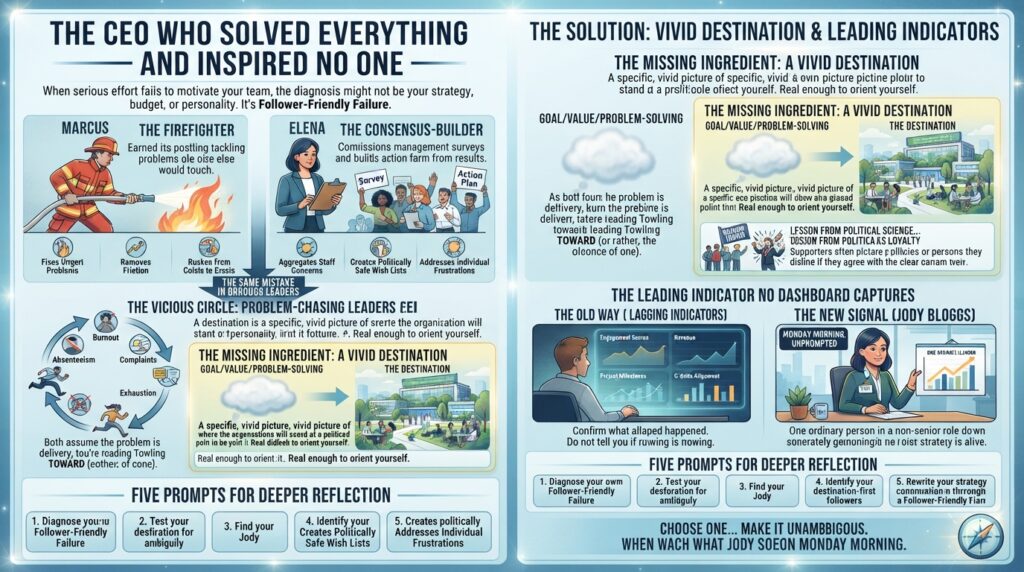
Marcus is a decisive firefighter. He earned his position by tackling the problems nobody else would touch, and he has been doing the same thing ever since. Elena takes a more consultative path. She commissions engagement surveys, listens carefully to what staff say, and builds action plans from the results.
Yet both are looking at the same uncomfortable numbers: absenteeism climbing, burnout reports rising, and employees quietly asking each other, “Where exactly are we headed?” Both assume the problem is in the delivery — the messaging, the resources, the rollout. They are looking in the wrong place.
The actual diagnosis is a pattern called “Follower-Friendly Failure.”
The Same Mistake in Different Clothes
Follower-Friendly Failure is the attempt to build organisational momentum by removing friction. Fix the complaints. Address the survey results. Solve the urgent problems. The instinct is generous — leaders genuinely want to make things better for their people — but the strategy is structurally flawed.
Marcus and Elena look like opposites: urgent problem-solver versus consensus-builder. But they are making the same error in different packaging. Their failure is not in how they lead. It is in what they are leading toward — or rather, the absence of any clear answer to that question.
Elena’s approach is particularly instructive. Aggregating staff concerns produces a politically safe wish list, not a strategy. It assumes that resolving individual frustrations will compound into collective motivation. It won’t. Addressing one round of complaints simply surfaces the next round. The circle is vicious, and staff eventually exhaust themselves chasing problems that regenerate faster than they are solved.
The missing ingredient is not smarter problem-solving. It is a destination.
In this context, a destination is not a goal, a value, or a problem to be solved. It is a specific, vivid picture of where the organisation will stand at a defined point in the future — real enough that an ordinary person can orient themselves toward it.
What Political Science Reveals About Leadership
Research on voter behaviour offers an unexpected window into how destination-clarity functions as a loyalty mechanism. Studies of Donald Trump’s coalition have consistently found that roughly 25–35% of his supporters privately dislike specific policies, find aspects of his persona difficult, and disagree with particular decisions. They back him anyway.
The reason is not charisma, party loyalty, or agreement with the plan. It is agreement with the destination. These voters know where he says the country is going, and that clarity holds them even when the specific steps, or personal foibles do not.
The organisational parallel is direct. Every leadership group contains a subset of destination-first followers — people who will tolerate management friction, imperfect policies, and even a leader they find personally disagreeable, provided they can see clearly where the organisation is headed. Marcus and Elena have no mechanism for reaching this group because neither has named a destination unambiguous enough to reach them.
This is what Dr. Riel Miller, a UNESCO senior adviser, calls Futures Literacy: the capacity to use the future as a resource for acting in the present. It requires holding the future genuinely open — treating several possible destinations as real — until a single, unambiguous endpoint is chosen. Once that commitment is made, something shifts. Inspiration and discretionary effort are not manufactured through communication techniques. They are released.
This distinction matters more than most leadership development programmes acknowledge. Charisma, communication skill, and policy competence are all useful. But none of them substitute for a destination that employees can inhabit in their imagination before they inhabit it in reality
The Leading Indicator No Dashboard Captures
Executives searching for evidence that a strategy is working typically reach for lagging indicators: engagement scores, C-suite alignment, project milestones, revenue shifts. These confirm what has already happened. They do not tell you whether the organisation is actually moving.
There is a better signal, and it costs nothing to detect.
Consider an employee — call her Jody — who works in a mid-level, non-senior role. Her department has been identified as high-leverage: it sits in the 20% of organisational effort that drives 80% of strategic results, directly connected to a 15-year destination the company has committed to.
Without a clear destination, that leverage is invisible to Jody. She spends Monday doing what she did the Monday before. This is not apathy. It is a rational response to ambiguity. When no clear endpoint exists, the safest professional behaviour is to replicate what worked yesterday. Jody is not the problem. The missing destination is.
With one — a specific, unambiguous endpoint she can picture and act toward — something different happens. On Monday morning, unprompted by her manager, she spends three hours doing something she has never done before: taking deliberate actions aligned with where the organisation says it is going. Not because she was told to. Because she can see the destination and has decided to move toward it.
Notice what did not cause this shift: not a town hall, not a revised KPI framework, not a team-building exercise. The destination did the work. Her manager’s job, once the destination is clear, is largely to stay out of the way.
That behaviour — one ordinary person in a non-senior role doing something genuinely novel in alignment with the stated direction — is the leading indicator that a strategy is alive. Engagement surveys can score well while this signal is completely absent. The signal’s presence means the destination has landed. Its absence means it has not, regardless of what the dashboard reads.
When enough Jodys emerge across an organisation, the needle moves. Not because leadership pushed harder, communicated more cleverly, or solved one more urgent problem. But because ordinary people with real jobs decided, on their own initiative, that the destination was worth moving toward.
The practical implication is uncomfortable for leaders trained in comprehensive planning: resist the pressure to make the destination inclusive. A destination designed not to alienate anyone ends up directing no one. Choose one. Make it unambiguous. Then watch what Jody does on Monday morning.
Five Prompts for Deeper Reflection
Use these with any AI assistant (or as journaling prompts) to apply the ideas in this article to your own leadership context.
Prompt 1 — Diagnose your own Follower-Friendly Failure
“Here is how I currently try to motivate my team: [describe your approach]. Based on the distinction between problem-fixing and destination-setting, identify where my current approach might be producing Follower-Friendly Failure. What am I likely missing, and what would a clearer destination look like in my specific context?”
Prompt 2 — Test your destination for ambiguity
“Here is our current strategic vision or mission statement: [paste it]. Assess whether this constitutes a genuine, unambiguous destination that an ordinary employee could act toward on Monday morning — or whether it is a wish list, a values statement, or a problem-solving agenda in disguise. Then suggest what a sharper destination might say instead.”
Prompt 3 — Find your Jody
“Our organisation has articulated the following strategic direction: [describe it]. Help me identify what a ‘Jody Bloggs’ signal would look like in our context — that is, what specific, observable, novel behaviour by a non-senior employee would indicate that our destination has genuinely landed, rather than merely been communicated.”
Prompt 4 — Identify your destination-first followers
“The article describes a subset of followers who are loyal to a destination rather than to a leader’s personality or specific policies. Thinking about my own team or organisation, help me profile what this group might look like: how would I identify them, what do they need from a destination to engage, and how might I be inadvertently failing to reach them with my current communication?”
Prompt 5 — Rewrite your strategy communication through a Futures Literacy lens
“Here is how I typically communicate our strategy to staff: [paste an example — a town hall script, an all-staff email, a strategic summary]. Rewrite this using Futures Literacy principles: remove problem-solving language, eliminate wishlist elements, and replace them with a single unambiguous destination that an ordinary employee could picture and act toward. Show me the before and after side by side.”
Today, your executive team fills SWOT boxes in 90 minutes and calls it strategy.
Tomorrow’s competitive landscape will punish that superficiality mercilessly. Chris Fox predicts the emerging standard: double-barreled insight generation that combines intellectual analysis with visceral pattern recognition.
The companies that master this before 2027 will spot their Kodak moments early enough to pivot. The rest will wonder why their strategy sessions produced such weak insights while competitors transformed entire business models. This conversation reveals the magnitude gap that will separate strategic survivors from casualties.
Tune in to hear from me and my special guest, Chris Fox, as we tackle and try to solve this wicked problem together. We’ll be putting our heads together to find new ways of discussing strengths, weaknesses opportunities and threats – SWOT – that go beyond the usual thinking.
I’m Francis Wade and welcome to the JumpLeap Long-Term Strategy Podcast
Chris Fox is a strategy consultant and founder of StratNav, the collaborative platform for business strategy development and execution. With over 26 years’ experience, Chris helps leaders replace guesswork with evidence and execution. He also runs Chris C Fox Consulting, advising C‑suite teams on strategy that delivers
In the early 1980s, McKinsey told my employer at the time, AT&T, that the global market for mobile phones would top out at roughly 900,000 subscribers by 2000.
The actual number was 100 million.
A decade later, AT&T paid $11.5 billion for McCaw Cellular to claw its way back into the market it had walked away from.
Hundreds of America’s brightest minds had read the same report, nodded at the same conclusion, and missed by two orders of magnitude. The forecast was polished, confident, and built entirely on data from the past. It was, in today’s vocabulary, trendslop — and it predated AI by half a century.
If you sit at the top of a company anywhere in the world, you are now being asked to make similar bets with a tool that produces trendslop on demand. A recent Harvard Business Review article, “Researchers Asked LLMs for Strategic Advice. They Got ‘Trendslop’ in Return”, called out the pattern directly. Ask a large language model for strategic advice and you get confident, polished output that sounds insightful — until you look closely and realise it could have been written by a competent intern in an afternoon.
The good news: your instincts about AI are right. It can sharpen your strategy work. It can also wreck it.
The bad news: no settled playbook yet tells you which is which.
The Iron Rule You Already Know
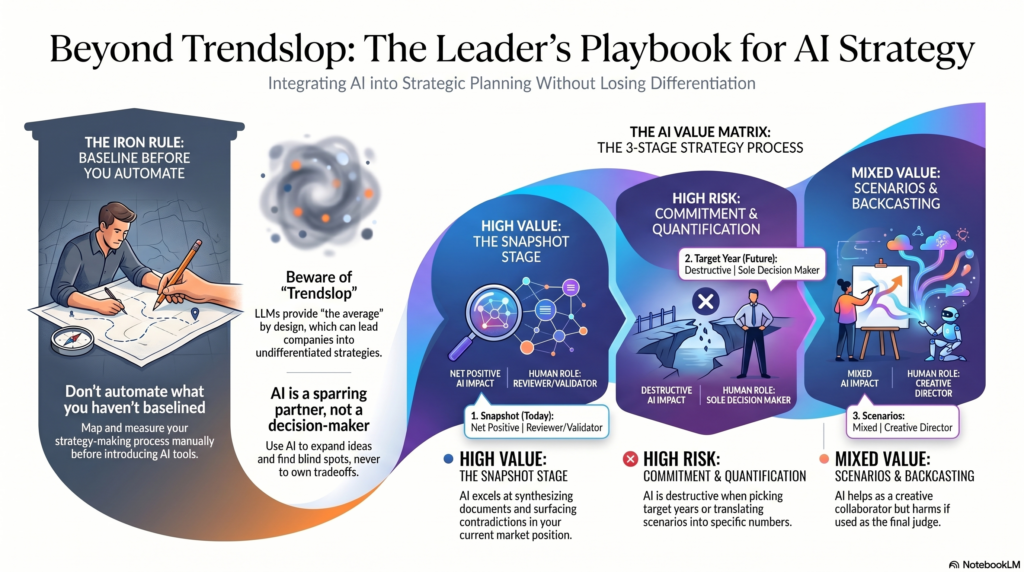
As a young internal consultant at AT&T, I learned a discipline that has aged better than most of the company’s 1990s forecasts: Don’t automate what you haven’t baselined.
The same idea runs through every quality programme Toyota exported to factory floors around the world. Before you mechanise a process, you map it. You measure it. You understand its variation. Only then do you bring in the machine.
The current rush to “put AI into strategy” ignores this rule. Most executive teams cannot describe how their own strategy actually gets made. Strategy creation happens once every two or three years. It rarely gets documented. Institutional memory leaks out with every senior departure. No baseline exists.
Then the LLM is invited in. And it produces — predictably — trendslop.
The problem isn’t the AI. The problem is that the iron rule was broken before the model was ever prompted.
Where AI Helps, Where It Harms
The EndPoint Method I use breaks strategy work into six stages: build a Snapshot of where you are today; pick a Target Year fifteen to thirty years out; generate Scenarios for that future; pick one scenario and translate it into numbers; Backcast milestones from that endpoint to the present; and only then build a Short-Term Strategy Map for the first two years.
Across more than sixty engagements, I have watched AI’s effect on each stage. The pattern is now clear.
AI is a net positive in exactly one stage: the Snapshot. Here, the work is synthesis — pulling together what is already known about your organisation, your market, and your competitive position. The LLM reads documents fast, finds patterns across them, and surfaces contradictions in your own data that the room had stopped seeing. It augments without replacing.
AI is destructive in two stages, and they happen to be the most consequential: Picking a Target Year, and Picking-and-Translating a Single Scenario into Numbers.
These are the moments of commitment. They demand differentiation — a stance that sets your firm apart from the average. An LLM, by design, gives you the average. It will hand you a target year that mirrors what every other company in your sector has chosen. It will quantify your scenario the way every scenario in its training data has been quantified. Use it here and you sleepwalk into the same future as your competitors.
The remaining three stages — Generating Scenarios, Backcasting, and Short-Term Strategy Mapping — are mixed. AI helps when used as a sparring partner. It harms when used as a decision-maker.
The Fix
Over the past year, my team has run strategic planning retreats with AI integrated at chosen moments and in a deliberate way — never as the source of commitment.
The pattern that works is consistent. The group defines the issue and its causes manually first — sometimes a recent trend, sometimes a decade-long problem. Only then is the LLM brought in, with a sharp prompt. For example: “Given the persona we have just described and the specific belief they hold, what three scenarios could shift their attitude?”
Within seconds, the group absorbs the conventional wisdom and moves past it. The LLM expands ideas, synthesises inputs, and surfaces blind spots the room could not see on its own. It is never asked to commit, to judge, to prioritise, or to own a tradeoff.
Decompose your strategy work. Insert AI only where it adds value. Keep human commitment, judgement, and ownership intact.
What This Quarter Looks Like
The executives who win the AI moment in strategy will not be the ones who feed their hardest questions to an LLM and hope for the best. They will be the ones who honour AT&T’s iron rule and Toyota’s philosophy of automation: baseline first, then mechanise.
So here is the work in front of you this quarter.
Do not ask the LLM where to take your company. Ask it to help you see what you already have. Build the Snapshot. Map your strategy-making process for the first time. Document the institutional memory before it walks out the door.
Only then, and only at the stages where it adds value, bring AI into the room.
Your suspicion was right on both counts. AI can improve the process. AI can also do damage. Baseline first. Then, and only then, automate.
Five Prompts to Take This Further
1. Diagnose your current practice.“Describe how strategy actually gets made in our company today — who initiates it, what inputs feed it, how decisions get committed to, and where the process is undocumented. Then identify three places where we are currently asking AI to do work we have never baselined.”
2. Audit your strategy document for trendslop.“Here is our current strategy document [paste]. Identify every statement that could plausibly appear in any company’s strategy document in our industry. Highlight the language that is generic, average, or undifferentiated — and explain why each phrase fails to set us apart.”
3. Build a working Snapshot.“Read these three documents: last year’s plan, our most recent board minutes, and our latest competitor analysis [attach]. Surface every contradiction between them, every unexamined assumption, and every gap in evidence. Do not propose solutions — only surface what is already there.”
4. Sharpen a scenario with an opposing view.“We are considering [X scenario] as the future our strategy is built around. Argue against it. Give me the five strongest reasons a sceptical board member would push back on this scenario, and the historical analogies they might cite.”
5. Pressure-test your commitment.“Here is the single scenario we have chosen and the numbers we have attached to it [paste]. Identify the three commitments we are implicitly making that the rest of the document does not acknowledge. Where would this strategy break if our chosen Target Year arrived three years later than expected?”
P.S. The impact of AI on strategy creation is forcing its way into our thinking every day. You wish you could keep up, but so much is changing so quickly that it’s hard. The good news is that this is the theme of our September 15-17, 2026 strategy conference. Save the date in your calendar!
In this episode, we continue our discussion of the AI-Powered Professional by returning to the AI Researcher persona. Picking up from the prior conversation (episode 149) on information overload and information toxicity, Ray, Augusto, and Francis explore how AI can help professionals move from traditional search toward more collaborative research, synthesis, comparison, and knowledge discovery. They discuss deep research tools, source verification, using multiple AI systems to challenge each other, Google NotebookLM as a grounded research workspace, AI-assisted book reading and writing, proactive information discovery, and the importance of treating AI research outputs as drafts or hypotheses that still require human judgment.
(If you’re reading this in a podcast directory/app, please visit https://productivitycast.net/150 for clickable links and the full show notes and transcript of this cast.)
Enjoy! Give us feedback! And, thanks for listening!
If you'd like to continue discussing The AI Researcher: From Information Overload to Active Knowledge Synthesis (Part 2) from this episode, please click here to leave a comment down below (this jumps you to the bottom of the post).
In this Cast | The AI Researcher: From Information Overload to Active Knowledge Synthesis (Part 2)
Ray Sidney-Smith
Augusto Pinaud
Art Gelwicks
Francis Wade
Show Notes | The AI Researcher: From Information Overload to Active Knowledge Synthesis (Part 2)
Resources we mention, including links to them, will be provided here. Please listen to the episode for context.
ResearchGate
Google Search
Google Scholar
Academia.edu
ChatGPT
Claude
Google Gemini
DeepSeek
Google NotebookLM
Google Alerts
Feedly
Feedly Pro
Zapier
Evernote
Evernote AI
Raw Text Transcript
Raw, unedited and machine-produced text transcript so there may be substantial errors, but you can search for specific points in the episode to jump to, or to reference back to at a later date and time, by keywords or key phrases. The time coding is mm:ss (e.g., 0:04 starts at 4 seconds into the cast’s audio).
Read More
Voiceover Artist | 00:00
Are you ready to manage your work and personal world better to live a more fulfilling, productive life? Then you've come to the right place. Welcome to ProductivityCast, the weekly show about all things personal productivity. Here are your hosts, Ray Sidney Smith and Augusto Pinault with Frances Wade and Art Gelwix.
Ray Sidney Smith | 00:19
Welcome back, everybody, to ProductivityCast, the weekly show about all things personal productivity. I'm Ray Sidney Smith.
Augusto Pinaud | 00:25
I am Augusto Pinaud.
Francis Wade | 00:26
And I'm Francis Wade.
Ray Sidney Smith | 00:28
Welcome, gentlemen, and welcome to our listeners to this continuation of our discussion on the AI-powered professional. In our last conversation, we were really defining the problem around information overload and many of the issues that the modern professional or knowledge worker really deals with as it relates to all of the information. In our lives today. And what we wanted to do in this episode is continue that conversation. And talk through really how to take the sometimes overwhelming amount of information, but the treasure trove of information that we have every day coming into our world and really utilizing it in productive ways. I think that today, Thanks to AI, we no longer need to think about the concept of a search engine. We need to really think about this from the perspective of it being a collaborative engine and there is this kind of reality that it could be considered an answer engine, a research engine, all of these kinds of ways in which we can coin it. There are lots of different use cases today. We're particularly focusing in on the research And these more sophisticated AI tools can now perform tasks previously reserved for a research assistant or for you to take intensive manual effort to produce. And so let's talk through some of the ways in which you're utilizing AI for research purposes. And let's think through perhaps some of the pitfalls that people fall into as they're trying to use AI for research.
Francis Wade | 02:12
I've been in a whole different world as a result of deep research in the last year. I remember before It was available. I used to do... Research via looking for documents like ResearchGate, I can search for a PDF using Google. I could search Google Scholar. You could go to academia.edu and What it would give back to me, these different sources, is Stuff that was close to what I was looking for, but not exactly what I was looking for. Matter of fact, it was often not close at all because I would have a specific question. And I'm trying to get a specific question answered. But I have to find somebody who actually answered that question in a document. Or maybe a book or in something. And usually I'd be looking for an academic source. And usually I wouldn't find anything.
So that's just, The game I would play was would be hunt and never find and that was 50%, 75% because I'd be looking for Esoteric stuff. Today, however, I have at my fingertips multiple A few different subscriptions to deep research and chat GPT does it for free up to a particular limit. And I can ask a very specific question. And to my shock, I can receive a plausible reply to my question Right. Pulls from credible sources for the most part. In the beginning, it When it first came out, they would pull from hallucinated sources, which was pain in the neck. But today... They've gotten to the point where They give credible... Specific answers to my very specific questions.
So my research has just multiplied by, it's hard to even compare what it was like No, Versal, what it was like before. Because I do so much of it now. It's really been a game changer.
So that's at the high level. The game is completely different for me right now. See you next year.
Ray Sidney Smith | 04:15
And it will be different in a year from now even. More so. As the technology gets better.
Francis Wade | 04:21
- I've told people that different parts of my work. Have undergone more change in the last year than in the last decade. 30 years before that, 20 years? And this is certainly one era that is completely different.
Augusto Pinaud | 04:37
Sometimes digging and research in a topic and sometimes more than the papers, find the books. What is the book that, okay, I read this book. Now, What other... Go. Into this line and with books go on the opposite line.
Sometimes it's not only The papers, it's the one to give a more... Book rented? What books? Hey, I'm dealing into... And sometimes once I want to deal or work or research into this particular idea, Bye. Where can I find those books? Because you think, okay, I want to get, how do you get granular and now fast? But then now how do you find those book, those authors, who are the authors who I'm researching this, the same areas that I'm research, it doesn't matter if they're agreeing or disagreeing with you, but how you find them, that was a labor Of love. A lot of times, to find those books and to find those authors.
And then after that, then you needed to start Figure out which one was good, which one was bad. That job? One from weeks to hours. And you in hours can get a list that is better than what I was able to produce in months. This gets very interesting, the issue. Who's this? The expectations that now the people have. Because for what you're describing, similar to mine, it's not only get the information, now that just you were able to get to the sources pass through. But the other part of the process is still, you need to still read it, still download them, still digest them, still trying to connect those dots. That is still takes the same amount of time, but then First part, it's fantastic. The issue I see with this is I find a lot of people who think that find the sources is enough. And find the sources is just a step one of X number of steps to be able to get to the next conclusion.
Ray Sidney Smith | 06:47
So I think about AI in a research context, when I say this is an AI researcher, Bye. That AI can still hallucinate. I know Francis is a little more, maybe more trusting than I am when it comes to these tools. But I've found ways to revalidate information even after it has pulled research And again, I Preface this always with everything I do with AI, I presume to be a first draft when it puts it out. And so I'm reviewing everything as though an intern handed it to me and it's an intern's work product.
So I need to make sure that it is correct. So we were all on the same page there. I think there are certain areas where AI is really good right now and where it will get better. I think that the deep research functions within all of the major tools that AI chat bots are pretty good right now.
So you have this deep research function in Claude Gemini, and ChatGPT. Personally, I've found that Gemini's does the best. I'm not sure why, but I just feel like it gets the most right when you prompt it correctly. And I don't like the verbosity around the deep research that Google puts out, but it's fine. It gets the data right, which is what I care about most. And that's one piece, which is you have this complex question and you need it to go out there and scour lots of sources and come back to you with an answer. And you don't know what the sources are. And I think in that sense, it can go ahead and find sources and then go ahead and do that analysis and synthesis that is really complex and therefore laborious and make it simpler.
Though Concern I always have with folks is that We're a little too trusting. So I'm going to, again, underscore the point that even after it does this research,...
In this episode, we continue our series on the AI-Powered Professional by introducing the AI Researcher persona. Ray, Augusto, and Francis discuss how AI is reshaping research, learning, and knowledge work by moving us beyond simple retrieval toward active knowledge synthesis. Along the way, they explore the problems of information overload, low-quality information, over-trusting AI-generated answers, news and social media overwhelm, and what Ray calls “information toxicity.” The ProductivityCast team also discusses practical ways to curate inbound information, reduce cognitive friction, use AI-generated briefs and drafts responsibly, and stay in control of your attention while working with smarter tools.
(If you’re reading this in a podcast directory/app, please visit https://productivitycast.net/149 for clickable links and the full show notes and transcript of this cast.)
Enjoy! Give us feedback! And, thanks for listening!
If you’d like to continue discussing The AI Researcher: From Information Overload to Active Knowledge Synthesis (Part 1) from this episode, please click here to leave a comment down below (this jumps you to the bottom of the post).
In this Cast | The AI Researcher: From Information Overload to Active Knowledge Synthesis (Part 1)
Ray Sidney-Smith
Augusto Pinaud
Art Gelwicks
Francis Wade
Show Notes | The AI Researcher: From Information Overload to Active Knowledge Synthesis (Part 1)
Resources we mention, including links to them, will be provided here. Please listen to the episode for context.
ResearchGate
Academia.edu
ChatGPT
Google Gemini
Google Workspace
Microsoft Copilot
Feedly
Evernote
Social Fixer
The New York Times
The Onion
Raw Text Transcript
Raw, unedited and machine-produced text transcript so there may be substantial errors, but you can search for specific points in the episode to jump to, or to reference back to at a later date and time, by keywords or key phrases. The time coding is mm:ss (e.g., 0:04 starts at 4 seconds into the cast’s audio).
Read More
Voiceover Artist | 00:00
Are you ready to manage your work and personal world better to live a more fulfilling, productive life? Then you’ve come to the right place. Welcome to ProductivityCast, the weekly show about all things personal productivity. Here are your hosts, Ray Sidney Smith and Augusto Pinault with Francis Wade and Art Gelwick.
Ray Sidney Smith | 00:18
Welcome back, everybody, to Productivity Cast, the weekly show about all things personal productivity. I’m Ray Sidney Smith.
Francis Wade | 00:24
And I’m Francis Wade.
Ray Sidney Smith | 00:25
Welcome, gentlemen, and welcome to our listeners to this episode of ProductivityCast. This week, we are going to be continuing our dive into the world of artificial intelligence, which I like to call smart software, with another episode in our series of the AI-powered professionals.
So today we’re going to be focusing on research and what I’m coining here is the AI researcher persona and how these new tools are really transforming the process of learning and researching and knowledge work for us. We’re moving to a place where we can understand retrieval as basically active knowledge synthesis. And we’re going to be talking through some of the challenges that folks face with regard to information overload and otherwise.
So let’s first talk through the problems with research today. What do you find are the good or the positives around research today? And what are some of the problems that we experience? One of them we’re going to talk about, which is information overload. But there are others that are out there.
And then we can give that context. Color with regard to how we can use AI as a researcher to help us with that process or those problems.
So what do you feel like are the primary problems today with research.
Francis Wade | 01:47
I think in the past, very much a hit or miss kind of proposition. Where if you could find someone who had done the research… Answer the research questions that you have. You were extremely lucky. And the game was, how can I increase odds of success how can I be luckier So that meant that dwelling in places like Research Gate. Maybe at academia.edu.
Yeah. But ResearchGate was my goal, though. And For certain topics, especially the two that I specialize in, which are task management and strategic. Planning. I’ve pretty much got to the bottom of everything that I could find easily. It took a few years for each one, but I’ve sort of gotten to what I think is like the bottom. Where I read what they have to say. And I’ve noticed sort of where all the faults are why in neither field the research academics do is very useful in the real world?
You know, it’s very esoteric and it’s meaningful. Academics tend to write for each other. And for journals. And for advancement in their field. They don’t like to go into areas that are cross bouldery that I like to mix and match different fields. They don’t go interdisciplinary. It makes a real mess of the nice, clean, lines that they like to follow. And I don’t like to go into areas that, you know, If you become an expert in an area where there’s no conferences and no journals, no chairs and no departments anywhere in the world. If you go into an area like that, you know, you’re sort of dooming yourself to obsolescence.
So with those problems, It means that for the two areas that I’m interested in, there’s a, Not a lot of useful research. There is to find.
So finding something useful used to be a lucky proposition. And I would have to basically find someone who has enough experience in both areas to be able to do research in both areas so that they would have the questions. And finding that was like a needle in a haystack.
So it’s always been difficult in the two areas that I Try to find research written on. It’s always been an uphill struggle.
Augusto Pinaud | 04:02
I think it’s important to make an distinction between professional researching practices and the non-professional one. I agree in the professional researching the impact of AI has been incredible because now these people who Say. Knows better when they’re trying to search and look into information. Cinta was not available. When you go to the noun informal research. It’s interesting because I feel that we used to have Three levels of research, bad research, middle ground research, and good research. And now with the AI, we have gone and disappeared that middle because people think that they can find the answer that they believe is legit. Doesn’t matter if it’s true or it’s fake information or what it is. They can go bump into any of these agents. Get an answer. And because of that, people stopped digging. Into is this really legit? But when you think in the world of productivity, When the first book of David Allen came out, we were talking about 2001, It was hard to find the information. It was hard to find the principles behind unless you have access to them. 25 years later, you can find A ton of information. The question now is, How did you know that information is legit or not? And that’s why I think that middle ground has disappeared. You have the people who goes and do a prompt, and get an answer and assume Dad. The answer they’re getting is the truth. And because of that, that’s the stop of the research.
So what was part of the issues 20 years ago is, okay, I want to research this topic and now I have 20 books. No, they just go, ask two questions, get what they think is a truth answer, and take that That’s a fact. Then you have the other level that is the people who are going to get that and try to figure it out. Is this a fact? They’re going to try to dig out or it’s not a fact. And what is the fact? What is interesting for me with AI is That middle ground, that guy who will have get that fact and tried to see why. I don’t look legit or not legit. That disappeared. What I have seen is people getting the output that AI is giving them I’m taking them. It’s a truth. It’s an absolute truth that is even more scarier. And I have seen this In academic settings, I have seen this in professional settings, okay, where people go What is the obsolescence of this? Okay. Can you repeat that? I didn’t get an answer.
So when that is, they never really dig. Hold on, did you want to do the vendor? Did you, did the chat GPT was floating you know, That, I mean, how been… Wonderfully. Last week. My son is a baseball fan, so he was watching the baseball and he wanted to see the score, so he asked, Madame Eyre. And But I may say, the game has not started. It was time for the game to start. That’s true. The radio. Fuck. And you know, like, You’ve got me in the life. Damn, man. Give us whatever is for them. I’ve nothing to do. With the reality. And it was a great moment of, teach an opportunity because of that. If we will have the initial answer, what most people do, This other game has no authority. Okay, and you move on. But the reality is minimal. The game had started. We were in the middle of the game and there was a different score than what she was giving us on the third answer. And that is what Most people don’t notice when they go into this research. AI will give you an answer. The question is if that answer is actually the answer or.
Ray Sidney Smith | 08:11
Not. When it really matters, right? Learning that the game is not trivial, maybe not to your son, but to the rest of the world, you know, when it’s… I will.
Augusto Pinaud | 08:19
Make sure to tell him that right thing, that when the game is on, it’s not trivial. You are going down in that scale of people he likes. You’re going down, my friend.
Ray Sidney Smith | 08:27
The unfortunate part is if you say, hey, I just swallowed this thing mineral….
You’re in a strategy retreat. You see an opening to shift the conversation—a strategic insight you know could change the trajectory. You speak up with confidence. And then… blank looks. Awkward silence. The room moves on as if you hadn’t spoken.
It doesn’t matter if you’re the CEO, the board chair, or an ambitious director. The frustration is identical: you have strategic clarity, you know the frameworks, yet your interventions land with a thud while others command the room effortlessly. Most executives diagnose this as needing sharper frameworks or better presentation skills. Wrong problem.
This episode exposes what elite strategists do differently: they’ve built pattern libraries from accumulated case exposure that allow them to deploy diagnostic stories, pattern stories, and origin stories in the moment—not in PowerPoint decks afterward. You’ll discover why Julius Yego’s YouTube-driven Olympic medal validates cognitive science research on tacit knowledge, how Samuel Berger’s “intellectual dark matter” explains the gap between knowing frameworks and commanding strategic conversations, and why the three-season development model transforms in-the-room impact when executive programs don’t.
For global executives who’ve exhausted conventional development paths, this reveals the hidden capability that separates persuasive pattern recognition from forgettable framework recitation—and the deliberate practice method that builds it.
Enjoy the full video of this episode below for all subscribers.
This is a public episode. If you’d like to discuss this with other subscribers or get access to bonus episodes, visit longtermstrategy.substack.com/subscribe
In this episode, we continue our conversation on The AI Assistant as part of The AI-Powered Professional series. Picking up from Episode 147, the ProductivityCast team shifts from using AI merely to offload administrative friction and shadow work to thinking about AI as a true collaborative assistant. Ray, Augusto, and Francis discuss how to define roles for AI assistants, train them with useful context, manage multiple AI tools and personas, review AI-generated work as drafts, and build prompt workflows that help professionals get better results while staying firmly in control.
(If you’re reading this in a podcast directory/app, please visit https://productivitycast.net/148 for clickable links and the full show notes and transcript of this cast.)
Enjoy! Give us feedback! And, thanks for listening!
If you'd like to continue discussing The AI Assistant: Automating Administrative Friction and “Shadow Work”, Part 2 from this episode, please click here to leave a comment down below (this jumps you to the bottom of the post).
In this Cast | The AI Assistant: Automating Administrative Friction and “Shadow Work”, Part 2
Ray Sidney-Smith
Augusto Pinaud
Francis Wade
Show Notes | The AI Assistant: Automating Administrative Friction and “Shadow Work”, Part 2
Resources we mention, including links to them, will be provided here. Please listen to the episode for context.
Microsoft Copilot
Google Gemini
Google NotebookLM
ChatGPT
Claude
Evernote
Zapier
Raw Text Transcript
Raw, unedited and machine-produced text transcript so there may be substantial errors, but you can search for specific points in the episode to jump to, or to reference back to at a later date and time, by keywords or key phrases. The time coding is mm:ss (e.g., 0:04 starts at 4 seconds into the cast’s audio).
Read More
[00:00:00] Are you ready to manage your work and personal world better to live a more fulfilling, productive life? Then you've come to the right place. Welcome to ProductivityCast, the weekly show about all things personal productivity. Here are your hosts, Ray Sidney-Smith and Augusto Pinaud, with Francis Wade and Art Gelwicks.
[00:00:18] Welcome back, everybody, to ProductivityCast, the weekly show about all things personal productivity. I'm Ray Sidney-Smith. Marco is jumping out. And I'm Francis Wade. Welcome, gentlemen, and welcome to our listeners to today's episode, where we're gonna continue our discussion on AI, and this is our series on the AI-powered professional.
[00:00:44] in our first episode, we started the discussion about the concept of utilizing generative AI. in this episode, we also started the process of talking about what an AI assistant is really [00:01:00] like, talking about some of those administrative frictions, being able to get rid of, and automate that out of, your world to some extent, and dealing with shadow work as well, defining shadow work and so on and so forth.
[00:01:13] We're gonna continue this topic into discussing today about really how to partner with your AI in a lot of ways, what the collaboration process really looks like. And so I'd like for us to discuss shifting using AI tools as a mechanism of just kind of offloading something, which it can do, but then becoming a more collaborative partner with that particular AI tool in order for it to become a true AI assistant.
[00:01:45] And so I'm thinking of things like how do we ensure that AI is taking over the right kind of work and that it's not taking over the work that we should be doing, and how do we maintain control and accuracy? And of [00:02:00] course, there are a bunch of boundaries and ethical considerations that we should be thinking about and some thoughts about the future.
[00:02:05] So let's start with what are some of those first principles, for us to be able to create a true collaboration partnership with our AI assistant?
[00:02:19] Sure. I'm thinking about this from the perspective that If I want to work with my AI assistant, I need to choose particular categories of work in which it can actually collaborate. So for example, I want it to be able to help me take a rough sketch that I've made on either my iPad or on paper, and then to have the AI turn that into a full-fledged drawing, a full-fledged cartoon perhaps.
[00:02:49] So the AI assistant is acting as my cartoonist, and so that's a role that I want the AI assistant to do. And while I can draw my [00:03:00] own cartoons, 'cause I've taken this drawing class, I feel competent to draw, you know, one part of a cartoon, but then it can fill in the rest by creating the other panels of the cartoon.
[00:03:13] And this is really helpful to me because now I can make the first drawing. It can be roughish, you know, to give it the idea of what I want, and now I can help it help me, quickly generate more panels and get the cartoon done by virtue of that. But the idea is that it's now a role that I want it to continually be helping me with, and so that is the cartoonist role.
[00:03:38] That's just one. I mean, like that, it doesn't, it doesn't have to be just role. It could be any number of things. But it's just like, that's the kind of thing that I'm thinking about. well, in the last episode, we sort of established the notion that, an AI assistant is like an intern who remembers everything, but doesn't have a whole lot of judgment.
[00:03:56] isn't, a really good judge of, you know, the [00:04:00] things, whatever it is that we happen to be expert at. It, it's too much to ask the AI to rise to our level of, insight and understanding. Having said that, there's a whole bunch of stuff that now looks to me that, it looks different to me because I can now see it as automatable.
[00:04:23] Like the example that you gave of, doing repetitive drawings or repetitive, animation. There's a bunch of things that I, and the list keeps growing, which is why I don't have a fixed answer. but it does start with this notion that I have an untrained intern that has infinite memory and infinite patience and doesn't have an attitude and works at all hours.
[00:04:48] And if I train that intern, then there's more and more things that the intern can do, and there's gonna be a new app tomorrow that- allows the intern to [00:05:00] do even more. So it's hard to say what specific role because the roles keep changing, and they keep being added to. if anything, I would say there's maybe a rule, which is that, try to give the intern as much as possible, but always be the person of last kind of decision.
[00:05:20] Be the one who's at the end checking to make sure the intern didn't make some, you know, gross error. So if there's any rule, that's the rule that I'm applying right now. Try to find more and more to give and then be the person at the end to do the checking. and then don't try to stress the intern out with judgment calls.
[00:05:42] and even the limit-- even the line on what I call a judgment call is changing with AI because it's getting better, You know, the AIs that I use, I use memory, so it understands me and what my judgment calls are, better and better each day. So it's a tough question to answer.[00:06:00]
[00:06:00] So just stepping up a level, I would say that just the concept of establishing roles for the AI is the first principle. It's not necessarily that you're going to ever be exhaustive in terms of creating the roles, because sometimes the role you need for a specific chat is defined in only that chat, and then there will be ones where you're gonna need that as an ongoing kind of recurring thing.
[00:06:29] It depends. You know, last episode I was talking about that wine help. You know, help me identify wine that I may enjoy based on my profile and educated that profile. But same thing on, on the professional side. I have a client who we, because of what they do, they, it's a report that is run every morning, and that report gets to them.
[00:06:53] And the problem is it's impossible to, to analyze it long enough. You know, you can see the report daily. You can maybe go a [00:07:00] couple days back. But human, it's hard to really create trends and things from that specific report. Where it's been very cool is a play on the role we create a chat for that neural network, okay?
[00:07:15] And now that report is dumped, for lack of a better word, into this chat. But this has now allowed us to identify trends not in three months, not in 90 days. Hey, this server last time this failed, okay, it was seven months ago. And it failed for three days. That information no human can provide for me. Okay?
[00:07:38] But allows you to start seeing that, and that make it very, very specific. Okay? Same thing, when you write. After you train, yeah, it required to train the intern, but after you train, say, "Okay, this sound like me. This doesn't sound like me." You know, one of the things that I love to do is when I get an [00:08:00] idea, okay, let me discuss this idea with the content of, okay, or the ideas or the understanding that AI has of X person.
[00:08:08] And you can say, "Hey, I want to look what will be the perspective of this text if Einstein read it." assuming you, you know what, physics and stuff. But that give you... Is the perspective you're going to get accurate? Well, it may be, it may not. But it will give you a counter that is very interesting.
[00:08:30] One thing that I do very often is find the arguments in favor and against this i- this concept, this idea that I'm working on. And it now get... You know, I think the definition, part of the definition or the issue is this, for a lot of people, is the first time they get access to an assistant, to an administrative assistant,
[00:08:53] For most people, that is a concept that they heard, that they, you know,...