Why 5-Year Plans Aren’t Strategic. They’re Dangerous

Almost all corporate plans cover the next five years. However, many companies go not a single month further. In other words, they survive on one five-year plan after another. If you have ever questioned the wisdom of this practice, keep reading.

Your strategic planning team meets and decides to limit its time horizon to only five years. Why? “It’s too hard to know what will happen in the future.” It’s true. The past two years have brought COVID, the recession, a war and other rude surprises. Companies’ best intentions lay in tatters.

Given the amount of change we have experienced, some say it’s folly to think past the short-term. In their mind, leaders will be so wrong about the future that it makes no sense to think too far out. The idea seems perilous.

If your managers are thinking along these lines, they aren’t alone. Around the world, the focus of attention has been on survival tactics. They keep the top line viable, limit costs, micro-manage workers performing their duties and secure supply chains.

Why then, should your company consider the creation of a new long-term plan? Here are three reasons we have gleaned in two decades of experience with clients who craft 15-30 year plans.

= Your 5-Year Plan is Just a Dull Revision

If your executive team is like many, it may be “mailing in” the strategic plan. In a half-hearted effort and minor revisions, the old plan merely becomes the new one.

Your Pre-COVID thinking is fully preserved.

This contrasts with the best companies, which are undertaking a fundamental re-think. They realize that more changes have taken place in two pandemic years than in the prior 20, shifting the underlying unmet needs of customers.

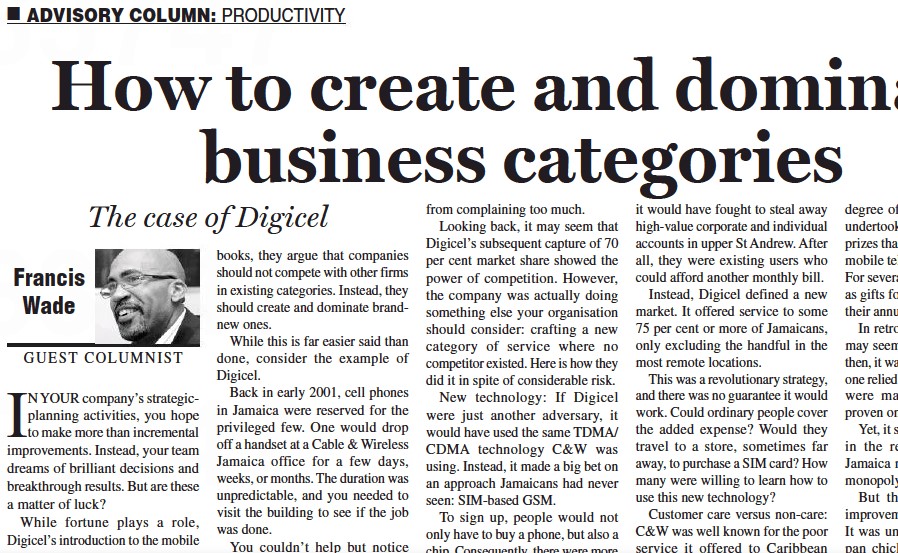
Furthermore, competitors are using the opportunity to craft “Blue Ocean” spaces which have never existed before. Consider the way Digicel entered the mobile phone market in 2001. Inside the walls of the incumbent, C&W leadership fought the notion of a pent-up demand for cell phones. The long lines on the first day of free competition propelled the new entrant to regional prominence.

If your company is too busy or lacks the energy to do a rethink, prepare for its own rude surprise.

= Your 5-Year Plan is For You, Not Them

While the Great Resignation is slow to reach the Caribbean, this hasn’t stopped the Big Disengagement. Your most talented and accomplished employees are withholding discretionary effort, searching for outside opportunities, and starting side-hustles in the meantime. Their faces are on the screen, but their dreams lie elsewhere.

However, when you announce a fresh strategy, their ears perk up. They want to see whether or not there is something worth staying around for.

Unfortunately, if all they hear is a “new” five-year plan, they will accelerate their plans to leave. It’s written proof: the company’s leaders are just as clueless as they suspected. And self-serving.

The fact is, a long-term strategic plan signals that the future is being secured by savvy creativity, rather than lost by selfish short-sight. It could craft a legacy to be celebrated.

= Your 5-Year Plan Ignores Technology Trends

The whole point of planning for a long horizon is to place intelligent bets now that shape the future. Understanding technology trends helps you do so effectively.

In your industry, these transformations have probably accelerated due to COVID. Companies who have accepted this fact and planned accordingly, are thriving. By contrast, the laggards are stuck teaching their employees how to use Excel and PowerPoint in face-to-face classrooms. They already failed. Perhaps they believed that the digital future would take care of itself.

Today, you know the truth. Organizations which fail to invest in younger, digitally savvy talent will reap the sour fruit of stale thinking. Their strategies won’t disrupt their industries.

This isn’t to say that it’s easy to create a 30-year strategic plan. However, some believe it can be captured in a nebulous vision statement.

Unfortunately, in today’s fast-moving world, these pronouncements arouse the suspicion of staff. Fancy words aren’t enough. Without a roadmap, they simply won’t trust grandiose statements which have no foundation.

To carve a credible route, adopt tools like back casting and the Merlin Process to connect the future to today. Yes…people want Big Hairy Audacious Goals (BHAG’s), but they must be grounded in feasible logic.

The timing may be right for you to create more than a mere five-year plan. It could exploit opportunities which, perhaps for a limited time, beckon your organization to achieve great things. It’s the best way to stay out of danger.

Francis Wade is the author of Perfect Time-Based Productivity, a keynote speaker and a management consultant. To search his prior columns on productivity, strategy, engagement and business processes, send email to columns@fwconsulting.com.

Leaders Failing to Adjust to Remote Work

As a manager, you may be in trouble. In the past two years, new ways of remote working have come out of nowhere and the debate is on: should you resume face-to-face working? Part of you wants work to be efficient, but another part hopes that everyone will come back to the office. Is this an unreasonable ask?

In your career, you probably have experienced a few micro-managers. With a patina of distrust, they hover over their people to ensure that they do what they are supposed to.

The sad fact is that this technique works, especially with manual workers. But it’s not faring well with knowledge workers. It’s hard to micro-manage in the COVID era. Why?

Stalking employees via WhatsApp or email messages just looks crazy. Installing software to inspect every keystroke feels like Big Brother. Calling staff randomly for casual “check-ins” can’t hide an unfortunate fact: they have lost their initiative.

The truth is, whatever intrinsic motivation they ever had has disappeared. Instead of being an excited newcomer to the organization, they have turned into drones. Now, they go through the motions, pretending to be engaged.

Consequently, you see yourself as the victim in all this…the unlucky recipient of poor employees. “If only I could get some good people,” you think, “I wouldn’t need to treat them this way.” You dream of a time when you could sit back as intrinsically motivated workers willingly produce their best work. How can you reach this end-point from where you are today?

  1. Fire Yourself

Here’s a shocking conclusion: your incompetence is showing.

What are you missing? The truth is: you don’t know how to manage people in a way that preserves their initial enthusiasm. Under your watch, staff with potential and energy become mediocre.

If this fits, consider getting rid of yourself: the part of you that COVID has revealed to be a weak manager. It may suggest that you quit the job, but here’s an alternative.

Instead, undertake a transformation in the way you manage. Start with a ruthless self-inventory of your performance. Ask for input from a coach, your immediate supervisor, and those who report to you. Pick an area to work on and start to make improvements.

  1. Upgrade Your Workers

In many cases, your company has hired employees who are not sufficiently self-directed. This has not helped. But if you have already undertaken a personal transformation that inspires others, you may also be making some more cynical. You must act on workers’ mindsets.

Partner with HR to build a process for identifying the most entrepreneurial recruits. Hint: they won’t be the ones who follow orders without question. Instead, look for people who could one day start their own business.

Why? An effective remote worker has more in common with a self-employed freelancer than a typical office worker. They manage their time, take responsibility for deliverables, and put work above insider-politics.

However, there will be some employees who can’t change fast enough.

  1. Transform the Culture

The majority of workers may not be bad: just used to an old way of doing business. It might be best to effect a cultural transformation.

In the change projects I have experienced, the end-result looks like an injection of personal responsibility. In other words, staff are willing to step up and say that things aren’t working, and publicly claim the part they are playing to fix them.

After all, the most responsible employees work well from anywhere. They empower themselves in the way they talk about their relationships. How? There’s almost no trace of the victim/poor-me stance taken by those who require constant supervision.

Once your organization starts to experience this shift, support the positive moves people make towards the ideal. Over-share so that folks come to see examples of self-motivation.

Also, paint a picture of how managers function in this new, remote dispensation. When behavior falls or degrades at any level, everyone should be able to identify it clearly.

But above all, resist a lazy slip into the way things used to work. For most companies, COVID has opened the door to a new kind of self-empowerment. Some staff have blossomed as a result.

Don’t drag them back to the office just because your least effective managers and workers are not delivering. Instead, forge a culture built around the most responsible staff. In other words, focus on creating more of what you want.

You are likely to feel uncomfortable waiting for the right answers to emerge. But don’t stop the search. You aren’t taking the path of least resistance; you’re fighting to bring forth a new normal.

Leaders Failing to Adjust to Remote Work

As a manager, you may be in trouble. In the past two years, new ways of remote working have come out of nowhere and the debate is on: should you resume face-to-face working? Part of you wants work to be efficient, but another part hopes that everyone will come back to the office. Is this an unreasonable ask?

In your career, you probably have experienced a few micro-managers. With a patina of distrust, they hover over their people to ensure that they do what they are supposed to.

The sad fact is that this technique works, especially with manual workers. But it’s not faring well with knowledge workers. It’s hard to micro-manage in the COVID era. Why?

Stalking employees via WhatsApp or email messages just looks crazy. Installing software to inspect every keystroke feels like Big Brother. Calling staff randomly for casual “check-ins” can’t hide an unfortunate fact: they have lost their initiative.

The truth is, whatever intrinsic motivation they ever had has disappeared. Instead of being an excited newcomer to the organization, they have turned into drones. Now, they go through the motions, pretending to be engaged.

Consequently, you see yourself as the victim in all this…the unlucky recipient of poor employees. “If only I could get some good people,” you think, “I wouldn’t need to treat them this way.” You dream of a time when you could sit back as intrinsically motivated workers willingly produce their best work. How can you reach this end-point from where you are today?

  1. Fire Yourself

Here’s a shocking conclusion: your incompetence is showing.

What are you missing? The truth is: you don’t know how to manage people in a way that preserves their initial enthusiasm. Under your watch, staff with potential and energy become mediocre.

If this fits, consider getting rid of yourself: the part of you that COVID has revealed to be a weak manager. It may suggest that you quit the job, but here’s an alternative.

Instead, undertake a transformation in the way you manage. Start with a ruthless self-inventory of your performance. Ask for input from a coach, your immediate supervisor, and those who report to you. Pick an area to work on and start to make improvements.

  1. Upgrade Your Workers

In many cases, your company has hired employees who are not sufficiently self-directed. This has not helped. But if you have already undertaken a personal transformation that inspires others, you may also be making some more cynical. You must act on workers’ mindsets.

Partner with HR to build a process for identifying the most entrepreneurial recruits. Hint: they won’t be the ones who follow orders without question. Instead, look for people who could one day start their own business.

Why? An effective remote worker has more in common with a self-employed freelancer than a typical office worker. They manage their time, take responsibility for deliverables, and put work above insider-politics.

However, there will be some employees who can’t change fast enough.

  1. Transform the Culture

The majority of workers may not be bad: just used to an old way of doing business. It might be best to effect a cultural transformation.

In the change projects I have experienced, the end-result looks like an injection of personal responsibility. In other words, staff are willing to step up and say that things aren’t working, and publicly claim the part they are playing to fix them.

After all, the most responsible employees work well from anywhere. They empower themselves in the way they talk about their relationships. How? There’s almost no trace of the victim/poor-me stance taken by those who require constant supervision.

Once your organization starts to experience this shift, support the positive moves people make towards the ideal. Over-share so that folks come to see examples of self-motivation.

Also, paint a picture of how managers function in this new, remote dispensation. When behavior falls or degrades at any level, everyone should be able to identify it clearly.

But above all, resist a lazy slip into the way things used to work. For most companies, COVID has opened the door to a new kind of self-empowerment. Some staff have blossomed as a result.

Don’t drag them back to the office just because your least effective managers and workers are not delivering. Instead, forge a culture built around the most responsible staff. In other words, focus on creating more of what you want.

You are likely to feel uncomfortable waiting for the right answers to emerge. But don’t stop the search. You aren’t taking the path of least resistance; you’re fighting to bring forth a new normal.

Having A Foot in Both the Future and the Present

As a manager, you may find it hard to engage in fruitful discussions about the future. You are able to speculate informally over lunch, but be unable to plan strategically in a formal session. You sense that this needs to change, but how? Where will this new skill-set come from?

Few things are more distressing in organizational life than a manager who was good at his old job, but still tries to perform it after being promoted. While he was elevated based on his technical ability, these are of little use now that employees report to him. They expect something new: leadership.

The same applies to the executive suite, and in particular the role of a CEO. More specifically, newly minted executives often don’t think strategically. The truth is, they gained their reputations based on reaching short-term results and fighting fires.

While every company needs middle-level managers who can demonstrate these skills, as leaders they are entrusted with something different: the company’s future.

If they are lucky, mentors take them under their wings, and deliberately stretch their capabilities with well-designed assignments and training. But this is rare. In general, a new executive’s lack of strategic planning skills isn’t revealed until the situation desperately needs them. By then, it’s too late. Instead, here are three competencies you can proactively develop.

  1. Thinking *about* the Future

I have met many CEOs and MDs who don’t talk about specific future outcomes at all. In their minds, all they need to do is react to stuff that might happen.

However, the best leaders don’t sit back: they create the future. For example, Facebook has a 15-year plan for the Metaverse which is intended to shape the way the internet is used globally.

By so doing, they confront the natural inertia of the vast majority who prefer to stay in their comfort zones.

As an executive, your job is to coach top managers to think about the future as a malleable object. They can become visionary. But you may need to do some convincing. In other words, you must educate, challenge and confront. And demote the unwilling or unable.

The fact is that as a member of the leadership team, you should develop the best long-term planning skills, and encourage others to follow your path.

  1. Thinking *from* the Future

While a good facilitator can drag any executive team through the creation of a specific vision, it’s not enough. Once it exists, the participants must take charge of the vision. Inhabiting it means thinking from the future, while they implement it in the present.

Some reduce this to a matter of project management, but it actually requires far more. Great leaders carry out special practices to help people think from the future. Examples include regular strategy updates using current information.

They also have a knack for bringing up the vision in everyday conversation. Each time, they create the specific future as the context behind every decision. By recalling its importance to stakeholders, they bring the future closer one step at a time.

Finally, they help staff see that Big Hairy Audacious Goals (BHAGs) must be translated into projects, then tasks. This connection is easily lost. Why? Daily emergencies hijack people’s attention, along with the distractions of social media/Netflix. To keep people on track, you should repeatedly bring the vision alive.

  1. Speaking from the Future

Unfortunately, very few executives know how to inspire others on demand. Call it a recurring failure of organizational life: the few who are inspiring often leave to start their own companies. Those who remain learn to survive the corporate grind by keeping out of trouble, rather than leading.

If this fits your story, you may be annoyed. Now that you have been promoted, you are asked to inspire staff. But where would you have learned to do so?

If the workplace doesn’t offer them, seek out other opportunities. Volunteer in your service organization, church or alumni association. Allow the discomfort of vision-filled speaking to become the norm. Experience the thrill of filling others with the hope of accomplishing remarkable things by working together.

In these challenging times with a pandemic, recession, and war ever-present, the natural human tendency is to withdraw and see performance fall. Great leaders realize this and put themselves at risk. This is your avenue to accomplish the extraordinary.

Start by telling the truth. If, as a CEO or MD, you have never been trained in this dimension, some honesty will help. Embrace this fact, and propel yourself forward with experiments which take you outside your comfort zone. Use the results to learn what works and become someone who can connect the future with the present. Your people are waiting.

Francis Wade is the author of Perfect Time-Based Productivity, a keynote speaker and a management consultant. To search his prior columns on productivity, strategy, engagement and business processes, send email to columns@fwconsulting.com.

Quit Complaining About Prior Strategies

Do your managers complain about key strategies their predecessors failed to craft? It seems as if they have all the answers, but you suspect that they may be kidding themselves. The truth is, they may not be very different. If so, how should you intervene so they don’t handicap future generations with more poor decisions?

Hindsight is 20-20 vision. After the fact, it’s easy to be an expert. On Monday morning, after the contest is over, you can say exactly what the coach and players needed to do.

The same applies to your company. If it’s been around for more than a few years, then your firm is benefitting (or suffering) from strategic plans created and applied by prior executives. They made some decisions (and failed to make others), forcing your organization into its current position. Like the Monday morning experts, it’s tempting to sit back and criticise them. With disbelief, you wonder out aloud: “What were they (not) thinking?”

However, as a leader, you could be committing the same mistake. In other words, you and your colleagues may be so engrossed with today’s issues that you are “kicking the can down the road” i.e. setting up traps for the next generation of managers. Essentially, you are abandoning them to a future they can’t influence today.

It’s a perpetual cycle which will only continue until your company is blindsided by a new competitor, technology, pandemic or other disruption. These occurrences are ones you wanted prior leaders to foresee, and prepare your company to handle. How do you break the cycle? What if you want to quit setting up new obstacles for your successors? Try these thought experiments, preferably conducted during a leadership retreat.

1) Imagine Your Organization Doesn’t Exist

In this thought experiment, ask yourself: “What if our organization didn’t exist?”

Look to the future and predict what would happen in your industry in regards to the products and services you deliver. What would customers and stakeholders come to expect as the norm? From whom? What new technologies or market realities would have an outsized influence?

Understand that your answers rely on present developments, maturing trends, and items becoming obsolete. In this experiment, you have no control – you can only observe.

The only real question to ask today is: What is your current relationship to these external forces? How are you preparing your company to deal with them? Unfortunately, many executives do little more than complain: “Someone should do something before it’s too late.” But they fail to act, only becoming victims. Don’t make this mistake.

2) Fast-Forward Far-Away Developments

Even if you can clearly discern market or technology trends, some managers won’t. They’ll pretend these threats can be ignored. Their inertia makes the company passive.

In a strategic planning exercise several years ago, we asked a leadership team: “When will a majority of Jamaicans prefer to use online banking?” After a long discussion, the group came to agreement: “2030.”

In today’s world, in light of COVID, we can see they were far off the mark. However, by back casting from 2030, they created a feasible course of action. As such, when the pandemic broke out, they could revisit their plan, have a laugh at their assumptions, and fast-forward their transformation. Instead of going into a panic, they made a tweak.

As you can imagine, future managers look back at this kind of exercise with gratitude. Even though it was inaccurate, it wasn’t incorrect. The same might apply to your industry and company with respect to inevitable changes that may arrive far more quickly than imagined.

3) Think in Terms of a Market Winner

Finally, imagine if all the competitors in the world were to disappear, leaving a single provider. Ask the retreat: “What did this team do to be the last one standing, serving customers, while others failed?”

Chances are, this is probably the company that invested early in some critical capability that others didn’t recognize.

Bring that thinking to your situation today. How do you ensure that you become more like Netflix/Apple/Fuji rather than their failed counterparts: Blockbuster/Nokia/Kodak? Can you stop postponing long-term decisions which guarantee your failure?

Arguably, there are few companies which arrived at their dominant position by accident. For example, Grace Kennedy’s competitors in the mid-1990s are no longer major players in their industries. Why? GK’s 25-year plan helped it surge ahead, via far-sighted moves some thought were foolish.

Don’t fall into that trap and inadvertently make your company obsolete. Instead, let future generations be proud of your decisions and willingness to set ego aside for the greater good. They may even thank you for your courage.

Francis Wade is the author of Perfect Time-Based Productivity, a keynote speaker and a management consultant. To search his prior columns on productivity, strategy, engagement and business processes, send email to columns@fwconsulting.com.

Resolving the Discrepancy Between Male and Female Work Ethic

Resolving the Discrepancy Between Male and Female Work Ethic

Have you ever wondered whether there is a real difference between the performance ethic of men and women? You don’t want to be biased, but if all things are not equal, it would be silly to pretend as if they are. Here is my experience – not a law or rule by any means, but some more data for you to consider.

Recently, I noticed a gap between the way women and men prepare to present at online conferences. Some background: my company has delivered five 3-day virtual events in the past couple of years. They attracted over 4,000 attendees, causing us to work with over 400 presenters.

Typically, we invite quite a much larger number of applicants. The best are offered speaking slots, which involves the production of a pre-recorded video. We offer ample instructions in the form of checklists and other aides to complete the process, which can take several hours from start to finish.

In our first conference, I noticed a difference between the way the male and female speakers completed their individual projects. For the most part (but not in every case), women were models of diligence. They followed the steps laid out and met assigned deadlines. Their work product was complete, and they asked fewer questions which were pre-answered in the provided materials.

I think the men would have been surprised to hear that they were the laggards by any measure. I was certainly shocked.

Four events later, I can say that the trend has continued. Whether the conference was Caribbean-based or not didn’t matter. The same behavior prevailed as men made a mess, while women anxiously over-performed. In fact, many of the latter were concerned that their final product might not be good enough.

By contrast, men’s submittals came in at the last-minute, with no apparent concern for its quality.

Fortunately, I function as part of a team with my wife, who has been on this journey from the beginning. Playing an equal role to mine, she is not surprised at all. After several conversations, I have concluded the following.

* Female presenters are putting in the hard work. Coming from a background of outright discrimination and exclusion, they have learned to eliminate the errors that would lead to them to “not being picked for the team.”

Furthermore, they are more likely to ask to be coached and are willing to accept guidance and put it to use. They seem to believe that the system is fair, leaving them free to focus on doing a good job.

* Male presenters appear to assume that deadlines are vague guidelines rather than operational requirements. As such, the consequences of doing their own thing are few. Feedback is rare, and if it’s offered, they are prepared to overlook it.

What are the sources of these very different behaviors? Here I can only speculate and I won’t generalize to entire genders in all situations. However, I do know that in my next conference, it would be a mistake to ignore the evidence. That would be bad for business. So take the following insights with a grain of salt, but maybe use them.

My male presenters have floated on a cushion of privilege. It truly is a man’s world…at least in their experience. As such, they can get away with rule-breaking at our events, just like everywhere in life. They need not pay close attention to changing times, or expectations. The sub-conscious assumption is that things will always work out in their favour.

As a man, I can confirm that this rings true.

However, some of my female presenters would be shocked to hear this account…at first. Upon reflection, they may realize that it explains prior experiences. Some can even cite supreme efforts to reach a high standard, only to see the selection of a man reaping the rewards of his sloppy work.

It’s unfair.

If you’re a man reading this, I encourage you to check your privilege. That safe cushion is probably being steadily deflated and when it finally goes away, you may be in trouble.

If there’s any good news, it’s that in some cases (like the one I described above), the facts are plain to see. The key for us all is to adjust our actions accordingly so that we are dealing with reality and helping others do so as well.

As managers, it makes no sense to ignore these truths. The fact that there are more female than male professionals in Jamaica is only one aspect of the picture: the part I thought was most important. Now, more than ever, I believe performance matters. Therefore, men will need to step up, just to keep up.

Francis Wade is the author of Perfect Time-Based Productivity, a keynote speaker and a management consultant. To search his prior columns on productivity, strategy, engagement and business processes, send email to columns@fwconsulting.com.

How to Manage a COVID-era Ineffective Employee

Is there at least one staff member in your office whose lack of productivity has been exposed by COVID? Before the pandemic, you had a favorable opinion, in general, of the person’s performance. But once they began to work from home, their output plummeted. How should you intervene? Is it worth the time and effort?

The fact is, you may be in a bit of shock. In each company, there are employees with diplomatic skills who excel in social gatherings, are constantly active via email and get along with everyone. They’re always available to help, playing the role of a consummate corporate professional. Some dress and speak with authority, enjoying a first-hand relationship with members of the C-Suite.

However, working from home has been a breakdown for them. While you couldn’t imagine an office without their daily presence, the pandemic has taken away their ability to impress. Now, they are being judged solely by their most recent outputs. Unfortunately, since March 2020, you can hardly point to anything they have created of significance. While others have shined, they have disappeared.

As you look back, you wonder. The truth may be that their performance was always lacking. Perhaps they just didn’t keep up with technology. Or new knowledge. A few were living on past successes, reminding everyone of their historic value.

Sadly, you conclude that they had become experts in “keeping” rather than “doing” their job. Now, you must make a decision about their future. Here are some steps to follow.

  1. Get the facts

Oftentimes in Caribbean companies, low performance goes unflagged because managers are unwilling to have difficult conversations. The result? Years of performance reviews which produced stellar reports. In short, there may be no written record or warning of any issues whatsoever. Any discussions which hinted at a problem are, in the past, forgotten.

If this is the case, in the absence of any other information, it’s safe to assume that the employees have no idea they have fallen behind. While they may have personal, private suspicions, don’t speculate. Most employees care about doing a good job and have some degree of anxiety regarding their continued employment. Don’t presume an emotional state.

Instead, focus on the facts and separate them from any interpretations which you have added. If you need to write them down for the sake of clarity, do so. By the end, each factoid should pass the video-tape test: visible actions that could have been recorded if a camera were available.

If you recall incidents which took place before COVID versus those which showed up after, all the better. However, if you have no facts; stop. You can’t take further action until you can satisfy yourself (and others) that it’s all not just a figment of your imagination.

  1. Prepare for the Conversation

With the facts in front of you, take time to prepare to have a difficult conversation about what they mean. If you have never used a feedback model before, find one you feel comfortable with. I prefer the Observation-Impact-Suggestion framework as a kick-starter. It begins with the observed facts, continues with their impact, and concludes with a suggestion.

Practice this conversation opener with a colleague. Ask them for coaching to make it as effective as possible, even as they roleplay extreme reactions.

When the time comes, be ready to have a lengthy exchange with your employee to come to some sort of agreement on a way forward. Be prepared to help.

  1. Confront the Work from Home Reality

Beyond this individual’s performance lies the reasons why this discussion must be conducted in the first place. Performance management in most regional companies is weak, a fact which COVID has revealed. In response, some managers are itching to go back to the way things were, when they didn’t have to confront low-performers.

Make no mistake: the newly exposed low-performers also want to return to the safety of the office. Hence, both parties are in an awkward spot. But they will receive no mercy from the high-performers, who have found ways to motivate themselves during the pandemic. Freed from micro-management and wasteful commutes, they have shined brightly; some for the very first time.

What would it be like to have a full complement of self-motivated staff? If you commit to such an outcome, don’t simply lapse into business as usual, acting as if COVID was just an unwelcome interruption.

Instead, grasp it for the opportunity it is to transform the culture of your workplace. This bump in the road could be a catalyst for breakthrough results. Perhaps it’s an answer to your prayers.

Writing Strategic Plans an Inside Job

Can someone from outside your company create your organization’s strategic plan? After all, if your future depends on the quality of this document, shouldn’t you hire an expert to do the job? At first glance, this makes sense, but as you contract with an outsider to execute the task, you may have misgivings.

As a consultant, I sometimes receive requests from potential clients (often via an RFP) to draft their strategic plan. It’s a bittersweet moment. While I’m happy to help, I also have a painful duty.

Now, I need to set about changing their mindset around the entire activity. Furthermore, I know something they don’t: these are non-negotiable. To be plain, if they refuse my efforts to change the definition of the project, I won’t work with them. What’s my reasoning for such a drastic demand?

  1. Strategic Plans Are Not Documents

While it’s the norm to equate a strategic plan with a document, the reality is quite different. It all has to do with where the document originates and what it’s intended to do.

The best plans lay out a very specific future. This is no 3-line vision statement with vague, undated aspirations which cannot be measured. Instead, it defines a detailed outcome and a realistic pathway to get there.

Ideally, its creation involves the top 10-18 leaders. Together, they seek to understand the current results and the external environment. Nowadays, this always includes the role of incipient and disruptive technology.

Once a baseline summary is created, a fresh, inspiring future can be defined. Usually, it’s selected from several possible candidates. Once the new vision is translated into numbers, it should be “backcasted” to the current year to produce a feasible

plan. This roadmap is converted into projects which are assigned to accountable individuals.

While there may be a document produced at the end of this process, it’s a poor facsimile of the hard conversations which preceded it. In retreats, we warn team members at the start: “Expect to make the 10 or so most difficult decisions needed to thrive in the future.”

Furthermore, they must do so with imperfect information. And they require courage to step into a world of uncertainty to declare a new Promised Land, even though they still live in Egypt.

As such, the document is optional – far less important than the final decisions, and the struggle to make them. Instead, the RFP I receive should focus on following rigorous, analytic steps as a team.

  1. There is No Real Delegation

However, there are companies in which the norm involves a CEO spending a weekend at a resort, locked away. During her hiatus, she writes the entire strategic plan. Her team receives the document on Monday morning.

One year, she may decide that she’s busy or needs outside input. She requests a quote from a consultant to perform the task instead. She explains: “My staff always agrees with the plan I come up with, and hardly give any comments. You should have no problem.”

When I share the bad news, she complains. “I just want you to write the plan, nothing else.” Is she making a mistake?

In a word, “Yes.” She hasn’t realized that her team has been left out of the process. Now, they are trained to give her “lip service.” They expect that by saying as little as possible, she’ll leave them to return to their operational, tactical jobs. Business as usual. They are “too busy to be distracted by strategic questions”, she complains.

By taking this path of least resistance, she makes a grave error. By relying on her strength alone, she under-estimates the need for their buy-in. Unless she’s in a tiny company, she actually needs them to do much more to succeed.

Instead, everyone in the leadership team should be engaged in crafting the strategic plan. This is the only way for the most important stakeholders to make challenging decisions. When she disappears for the weekend, she discounts their input.

Furthermore, she acts as if implementing the strategic plan involves no more than ordering people to play their part. This approach is far inferior to the alternative: involving the leadership team so that they can, in turn, engage others.

The bottom-line is, she’s been following a process that doesn’t work. Delegating it to an outsider only makes things worse.

If a consultant is employed, that may help. But the outside assistance shouldn’t diminish the challenge, it should only improve the experience and the final output.

True strategic planning, especially in these turbulent times, is no vacation-like exercise. It involves far more than prose. Instead, the stakes should always be high. The responsibility to confront tough choices and implement them lies with the leadership team.

Why “Short-Term Strategy” is a Misnomer

Have you ever been stuck in a strategic planning session, complaining to yourself: “This is nothing more than a continuation of old, tired thoughts?” You need to intervene and somehow shift the level of thinking. But you don’t know what to say, and you certainly don’t want to make things worse. Do you suffer in silence? Or attempt to provide some leadership?

The truth is, you may already be someone who has been looking ahead and wondering why your company isn’t seeing the future the way you do. If you are, realize that this is uncommon. Most of your peers are fine going with the flow.

Want to be different? Don’t sit back waiting for a juicy, post-retreat “I told you so.” Instead, harness your commitment by challenging your team to think strategically. Here are some ways to steer the ship.

  1. Insist on planning for the long-term

Start by insisting that “strategies” are not the same as “tactics”. In this vein, there is no such thing as “short-term strategies”. Tactics should only exist to implement a strategic plan, which should always be long-term. While it’s entirely possible to engage in daily tactics without a strategy, it’s not likely to be sustainable. At some point, your lack of foresight will lead to actions which make things worse.

While some say they have a “long-term, 5-year strategy”, you should immediately object. Once again, there is no such thing. If asked, explain that a 5-year strategy is just a lazy extrapolation of past events, plus a few tweaks. It’s the easy way out – the path of least resistance.

However, this is the same thinking that dooms companies. There’s a reason GraceKennedy created a 25 year strategy in 1995 and subsequently left its competitors in the dust. Most can’t even remember who they were.

Remember Kodak? The reason Fuji (their arch-rivals) became a chemical company as Kodak went bankrupt is a case study in short verus long term thinking. In 2000, both were on top, but only 12 years later, Fuji’s pivot was paying off while Kodak was reaping the results of stale, tactical judgment.

The point of a long-term strategy is to future-proof the organization, and assure its ongoing success. That won’t come by restricting your thinking to the comfortable future, as Kodak did.

Instead, your company needs to look over the horizon and pick a destination. In other words, it must be like Columbus. Fellow sailors in the 1490s were afraid of sailing off the edge of the world. Today, managers are just as scared to craft plans too far into the future. Consequently, they limit their companies.

  1. Emphasize the next generation

Short-term planning also tends to be a selfish exercise, by default. After all, it’s only human to care about oneself first.

However, a team which creates outcomes 15-30 years in the future instantly turns on a switch. As if by magic, it automatically focuses on the next generation.

For example, a Caribbean company that intended to enter Latin America crafted big market-share goals. However, via detailed planning, they discovered they would need a headquarters in Miami. Over time, the corporation would become American.

After confronting this fact, they decided not to permanently disenfranchise future generations of Caribbean leaders. To keep the company in the region, they scaled back the plan significantly.

But even in the face of such useful thinking, some argue that technology is moving so fast that you can’t plan for it. However, in long-term planning sessions, teams learn that customer’s core needs don’t change. The only question they need to keep asking is, “How will they be fulfilled?”

In this context, technology changes the way customers’ unmet needs are addressed, so emerging innovations must be considered. But the overall goal of serving customers doesn’t change from one generation to the next.

Therefore, the main question to ask now is “Where is our company headed in the long-term, and what technologies and human capabilities should we invest in…today… in order to get there?” Good answers are hard to find, yet executive teams have no choice but to embrace the struggle. Why? In part, they will always have limited information. And disruptions have become a fact of life.

In the face of these limitations, you must still employ long-term thinking. As Churchill said, “Plans are of little importance, but planning is essential.”

The point of a long-term exercise is not to be correct. Or accurate. Instead, it’s to engage in the difficult planning and decision processes that can make or break an enterprise. As a participant in a session, it’s a worthy challenge to inspire your team to tackle.

Francis Wade is the author of Perfect Time-Based Productivity, a keynote speaker and a management consultant. To search his prior columns on productivity, strategy, engagement and business processes, send email to columns@fwconsulting.com.

Strategy: Intentions or Predictions?

As a leader of your company, you may notice managers and board members struggling to be strategic. Trapped in low-level thinking, they habitually think micro when macro is needed. How do you help them craft inspiring visions that shift the way your organization operates?

At the start of each year, it’s only natural to aspire to be new, lofty and game-changing. As your followers look to you for direction, you know you need to say “something”. But the past couple of years may have led you to become cautious.

Perhaps your COVID-era plans now seem like bad jokes. You went out on a limb and called for big results, only to see them crushed. Today, you are gun-shy. You would be happy to exit 2022 without being forced to close your business. And if you don’t own a company, you just want to keep your job. It’s only natural to “small up” in the face of such realities.

However, these are exactly the fearful instincts that will turn out another Blockbuster Video, Nokia or Blackberry. They crashed out of industries they once dominated in a matter of years.

What do you need to do to lead your company effectively from the future rather than the past, even when your recent track record has been spotty?

  1. Stop Trying to Predict

By definition, a prediction is an extrapolation of the past. In stable, predictable times, you could use this tool to plan the future and your strategy.

But that’s exactly what you were taught. Your job as a manager was to produce results in the short term based on the recent past; tactical thinking that won’t help you when strategy is needed. Unfortunately, those days are over.

Now you must lead even if your prior predictions were terribly wrong, and you looked bad, foolish or stupid. Your natural tendency may be to think in shorter time-frames in order to make fewer mistakes.

As a leader crafting a fresh future, you need to stop predicting. Coming up with a new vision was never about making predictions and never will be.

  1. Replace Predictions with Intentions

The best strategic planning is about crafting intentions rather than predictions. They are always born in the future. Imagine a six-year-old saying “I want to be a doctor!” Good parents don’t scoff at such intentions, even though they aren’t based on facts.

However, the same child, if asked to predict, would probably say, “I want to keep playing with my toys!“

As an adult, you should gather all the facts you can muster. But at the end of the fact-finding, you must still craft an intention that is merely informed by the data, not limited by it. In other words, there will always be a risk when creating intentions which are meant to be ground-breaking, or transformational.

But what if your last few intentions produced nothing at all? What should you do then to be an effective leader?

  1. Close Out Prior Intentions and Craft New Ones

Even if recent efforts have failed, your organization still needs you to lead from the future. However, you could be hampered by your track record.

If so, consider bringing previous intentions to closure so your followers can hear a new one.

This may sound challenging or painful, but it isn’t. Simply take a critical mass of employees along a journey to explore the facts regarding the last failed intention. Doing so will lay the ground for whatever is coming next.

But be clear about your role. As a leader, you are the limiting factor. When you fail to create an effective, inspiring vision, don’t expect your managers to take up the slack. Their skills are limited.

However, as the leader, you have no excuse.

Your job is to get up in front of your staff each and every year with a vision of breakthrough results. When you shy away from doing so, you are dooming your organization. Don’t be surprised when it returns the favor with mediocre performance.

Seems impossible? If you can’t manage, get expert help. As the new year starts, your company needs you to be at your best, on top of your game. Call your personal development the recurring price to be paid by anyone who is in your position.

Also, you may need to train your managers and board members to think from the future, and be inspiring. At the very least, they should understand what a strategic vision is meant to do, so they don’t become obstacles.

But the buck stops with you. It’s your job to demonstrate that everyday management may be about predicting, but strategic leadership is about crafting inspiring intentions.

In summary, your people want to be led. As the occupant of an executive position, do your job.