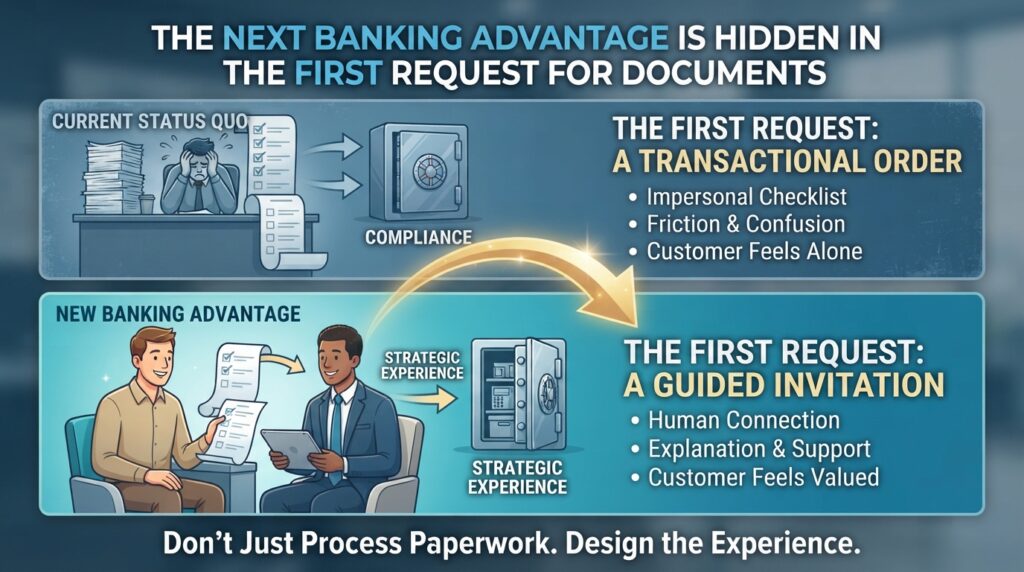
Think of a call you have taken more than once. Someone you respect, perhaps a former colleague, a relative or a friend who has always paid on time, is describing an afternoon at your bank that went badly. They wanted to move some money, open an account or make a routine withdrawal. They were handed a checklist, they brought everything on it, and then the checklist grew.
You listen, you sympathize, and then you say what bankers everywhere say. Anti-money-laundering and know-your-customer rules, set by the central bank or another financial authority, allow no exceptions, so the conversation ends there. Your hands are tied.
Or are they?
THE LOOP YOUR CUSTOMERS KNOW
The people who meet this loop most often are the ones without a private banker or adviser to absorb the friction for them. They arrive at a bank for something they believe is simple and submit exactly what they were told to submit. Each round of paperwork produces a new request, and each new request asks for something harder to find than the one before. Some of the documents are decades old, some sit in other institutions, and some no longer exist.
Eventually the customer quits, tired and relieved in equal measure. They find another way to manage that is far from ideal but less painful, and they tell friends and family the whole story. Prospective customers hear it long before they walk through your door.
I know this from the customer’s side. A financial institution once asked me for the original of a document that was forty years old, the kind most people have lost or never kept. No one had asked me for it before, and I was lucky enough to have it. I had also been promised the process would be easy, yet a basic withdrawal still took five confusing forms and a trip to the branch. I kept wondering what happens to the customers who do not have the document.
A DEFENSE THAT IS HALF TRUE
Banks have settled on a standard defense: the rule is out of our hands. It is half true. The rule fixes what must be verified. It says nothing about how a customer is prepared for the request, guided through it or supported when something goes wrong.
In meetings you will hear the same five lines: we have no choice, we cannot take chances, our hands are tied, we have bigger priorities, and customers just have to deal with it. Each one treats the customer’s experience as weather, something that simply happens.
Most institutions have merged the two questions into one. They measure the transaction, such as turnaround time and completed files, and treat everything the customer felt as an unfortunate by-product. In many institutions compliance owns the rule, operations owns the form and nobody owns how the customer feels.
TWO LAYERS, ONE ENCOUNTER
I find it useful to split the encounter into two layers, a distinction that owes a debt to Joe Pine’s work on the experience economy. The transaction layer holds the requests, promises, forms and documents. The experience layer holds how the customer feels at each of those points, and whether anyone is managing it.
Take the very first request for information, usually a templated email. It is accurate, it satisfies the transaction layer and the employee who sent it did the job. But the person reading it is alone, with no one on the line to explain the reasons, answer questions or handle the disappointment. A message that was correct on paper lands hard in the experience layer.
WHAT MEDICINE WORKED OUT
Doctors face a harsher version of your problem every day. They cannot change a diagnosis, yet medicine treats the way a diagnosis is delivered as a design problem in its own right.
Medicine also knows what failure looks like. According to news reports, a 78-year-old patient in intensive care in California was told by a doctor on a video screen, mounted on a remote-controlled machine, that his lungs were failing and comfort care was the only option. His family described the exchange as impersonal and devastating, and he died the next day. The clinical message may have been unavoidable. The method of delivery added to the distress.
Its successes are just as instructive. SPIKES, a protocol taught to clinicians for breaking bad news, structures the conversation into six steps. One of them is obtaining the patient’s invitation to share information, which is a long way from handing someone a list of demands. Ariadne Labs built a program around serious-illness conversations, with guides, training and implementation support for the institutions that adopt it, and it reports that about 80 percent of patients found those conversations worthwhile. The illness stays exactly as it is. What changes is how the patient meets it.
Controlled evidence exists too. In a randomized trial, 30 oncologists took a two-day communication workshop and researchers surveyed 1,192 of their patients. Patients of the trained oncologists reported lower depression scores at follow-up than those of the control group. Their satisfaction with communication style did not improve significantly, a result I find useful because it warns against judging an intervention by a satisfaction score alone.
I am not suggesting that a KYC request resembles a terminal diagnosis, and I do not know whether medicine’s methods carry over to banking. That is a hypothesis waiting for a test. The principle, though, travels well: a fixed requirement can be delivered in very different ways.
FIXES THAT MISS
Well-meaning fixes tend to miss. A new app or portal that asks for the same documents is the same demand in a modern wrapper. Courtesy training without the ability to explain the process leaves staff apologizing for something they cannot clarify. Longer checklists and FAQs raise the volume of information without raising understanding. Satisfaction surveys record frustration without turning it into a test at the point where it occurs. A single script for every employee ignores that a first-time customer and a seasoned one need very different explanations.
WHAT AN INVITATION LOOKS LIKE
Consider the first request for documents, the one moment every customer meets at every bank. Today it arrives as an order. Within five years, I expect at least one institution to decide it should arrive as an invitation.
What might that look like? A person calls before the checklist is sent, explains what will be needed and why, and says what happens if something is missing. Four practices make that repeatable:
– Structure the encounter. Plan how the conversation should unfold, in addition to what information must be conveyed.
– Train for emotion. Teach staff to recognize confusion, fear, embarrassment and anger, and to respond to each.
– Rehearse the hard moments. Use realistic scenarios and feedback instead of a policy manual and a courtesy workshop.
– Measure the experience. Test whether customers felt informed, respected and supported, and not only whether the paperwork arrived.
Every verification step stays in place. Nothing here weakens compliance. What changes is how compliance feels to the person on the other side.
WHY THIS WOULD DECIDE WHERE PEOPLE BANK
Why would this sway anyone’s choice of bank? I expect rates to keep converging and apps to keep looking alike, which leaves fewer ways for an institution to stand apart. The first request for documents is different, because every new customer meets it and most banks handle it as a formality.
An institution that turns that moment around gains something rivals will struggle to copy, since it cannot be bought with a rate cut or a new app. It has to be designed, taught and practiced.
A NAME FOR THE DISCIPLINE
I call this discipline SCOPE, short for Strategic Customer Opportunity and Performance Edge. It starts from the idea that a mandatory transaction and the experience around it are separate design problems, and it treats the experience as something a leader can own, test and improve. I cannot point to a bank that has done this end to end. What I describe is a scenario, and it needs a pilot before it can become a case study.
BACK TO THE CALL
The next time that call comes, the rule will still be there to explain. So will the question of who in your institution owns how that customer felt. The rule fixes what must be verified. How you ask is yours to decide, and the first institution to treat that freedom as strategy will turn a pain point every customer shares into a reason to recommend it.
Its competitors will be left wondering where their customers went.
——————————
The article was inspired by a Gleaner column and developed with the help of an LLM.
You can hear my podcast interview with Joe Pine on StratCinema.
————-
PS: Five prompts to try with an AI assistant
If you want to put these ideas to work, paste any of the prompts below into an AI assistant such as Claude or ChatGPT, and replace the bracketed parts with your own details. Leave out customer names and personal data. Treat what comes back as a starting point for your team to test, since an assistant cannot know your regulatory requirements.
1. Separate the two layers
“I work at a [bank / insurer / investment firm]. Walk me through our customer’s first request for documents in two columns. In the left column, list what the transaction layer requires: requests, promises, forms and documents. In the right column, list what the customer is probably thinking and feeling at each step, and who in our organization, if anyone, is managing that. Ask me questions about our process before you start, and mark anything you are assuming.”
2. Redesign the ask as an invitation
“Here is the first message we send customers asking for documents: [paste your template with names removed]. Rewrite it as an invitation. Keep every required document and verification step exactly as written. Add what the customer needs in order to feel prepared: why each item is needed, what happens if something is missing, and who they can contact. Then list anything in your rewrite that I should check with our compliance team before using it.”
3. Rehearse the hard conversation
“Play a customer who has just been told they must provide [an older or hard-to-find document] before completing [a routine transaction]. You are [confused / embarrassed / angry]. I will play the staff member. Respond as a real customer would, without making it easy. After six exchanges, step out of character and tell me which of my responses helped you feel informed, respected and supported, and which did not.”
4. Find the owner
“Our customers meet these moments in order: [list your steps, from first request to account opened or transaction completed]. For each one, help me identify who owns the rule, who owns the form, and who owns how the customer feels. Where the answer is nobody, suggest what a single accountable owner could do first. Also suggest one measure for each step that captures the customer’s experience instead of only speed or completion.”
5. Test the hypothesis
“I believe our customers’ experience of mandatory document requests can improve without changing any compliance step. Design a small pilot for [one branch / one customer segment] lasting [eight weeks]. Include what we would change, how we would measure whether customers felt informed, respected and supported, and what result would tell us to stop. Warn me about ways the pilot could mislead us, for example relying on a satisfaction score alone.”