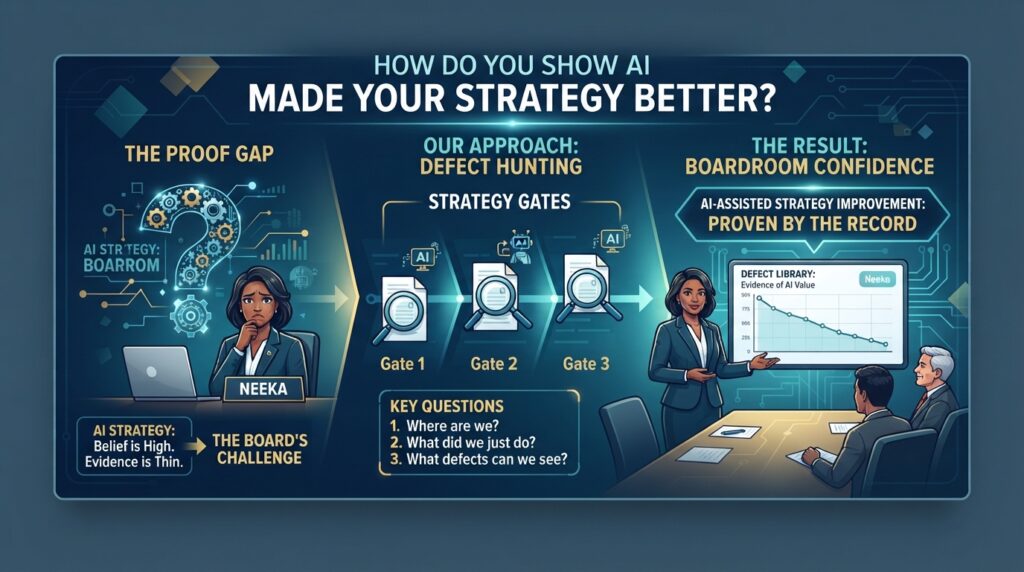
Neeka leaves the boardroom rattled.
Her team had done the hard work of building AI into the company’s strategy process. Her presentation was thorough. The board still wasn’t satisfied.
“How do we know this made the strategy better?” a director asked.
It was a fair question. Researchers have a name for what boards fear: trendslop, the generic, fashionable advice that language models tend to produce whatever your company’s situation. Neeka’s team had worked hard to avoid it. She couldn’t prove they had.
The board told her to use AI. Now it wants evidence that using it paid off.
What does she show them?
The proof gap
Neeka isn’t alone.
A Financial Times/Infosys survey of 300 directors at large North American companies found that 75% expect AI to significantly improve strategic decision-making. The same report warns that “decision quality does not improve by default.”
CEOs are more confident still. A Harris Poll for the software firm Dataiku asked 500 CEOs. Some 89% believe AI can write an equal or better strategic plan than one of their own executives.
Belief is high. Evidence is thin.
Capgemini surveyed 500 senior executives at companies with revenue above $10 billion. Some 47% reported noticeable gains in decision quality, though that is self-reported. And 52% listed their inability to verify AI’s output as a concern. Only about a quarter of their organisations have systems to validate it.
So leaders expect better strategy, say they’re getting it, and worry they can’t check. Your board will notice the gap.
Your first instinct
Neeka’s first instinct is sensible: take a workflow first approach, and borrow from process management.
TQM, Lean and Six Sigma carry decades of guidance and a deep library of case studies. Measure the work. Standardise it. Cut the variation. Few directors would argue with a method that is proven and countable.
Then consider 3M.
In 2001 the company hired James McNerney from GE. He brought Six Sigma with him and applied it widely, research labs included.
3M emerged financially stronger. Many researchers chafed. One R&D leader later described the company as “tool happy.” McNerney’s successor, George Buckley, de-emphasised Six Sigma in R&D.
Six Sigma suited the plants. In the labs, it was the right tool in the wrong room.
Strategy is lab work
A factory aims to repeat itself perfectly. Strategy aims to produce something different from last time.
Take Jamaica, in the Caribbean. Its national development plan, Vision 2030 Jamaica, runs out in a few short years. A successor that simply stretched it another twenty years, a possible Vision 2050, would waste the exercise. A national plan should break new ground, the way a lab does.
Corporate strategy has the same job. So how do you improve work that never repeats?
What the Army learned
One organisation faced this problem decades ago.
In the 1970s the US Army wanted to learn from its training exercises. No two missions are identical, so a fixed process couldn’t be the thing the Army improved.
It built the After Action Review: a short session after the event, built on four questions. What was supposed to happen? What actually happened? Why the difference? What should we sustain or improve? A facilitator leads it, usually not the most senior person present.
The Army improved a set of questions, rather than a set of steps. Strategy can borrow that.
At the same time, the review has a limit. It looks backward.
Moreover, a strategy’s results take years to show, and many other factors intervene along the way. That’s too late.
You need questions you can ask while the work is still open, before the strategy project ends.
Catch it before it ships
Software teams solved a version of this.
At PayPal, an engineer writes a one-page proposal describing the problem and the proposed design. The team then runs a pre-mortem. They assume the design failed and work out why. The engineer fixes what turns up before building.
PayPal says the practice catches issues early and exposes blind spots. That’s the company’s own account, not a measured result, and it comes from software design, not strategy. It’s the closest documented model I know of.
A pre-mortem is a defect hunt. A defect, in this sense, is anything wrong with the work that you can name, rank and fix.
Name your defects and you can show you removed them.
A grade isn’t a defect list
Some leaders already use AI as a critic.
Salesforce CEO Marc Benioff described his routine to the writer Bernard Marr. Each January he drafts his annual plan. He used to refine it with another executive. Now AI joins as a third collaborator. He asks it to compare the plan with his competitors’ and to “give me a letter grade.” He also asks where the plan is weak and where it is strong.
Smart habit. In the account I read, though, Benioff doesn’t say what the grade rests on. A letter says how a plan scored. It doesn’t say what was wrong, what you fixed, or whether this year’s process beats last year’s. A defect list answers all three.
Capgemini’s guidance on tracking AI-assisted decisions lists KPIs such as compliance scores and decision turnaround time. Those measure compliance and speed. They say little about the quality of the strategic choices.
SPEAR: your first experiment
I see the business world developing defect detection for strategy creation. The one I use with clients is SPEAR: Strategy Process Engineering for Analysis and Refinement.
It builds on the six stages of my EndPoint Method: a snapshot of where you are, a target year, scenarios, one chosen alternative expressed in numbers, a backcast from that endpoint, and a short-term strategy map.
SPEAR adds a short defect check at each gate between stages. At your next gate, pause the work for a few minutes and ask:
1. Where are we?
2. What did we just do?
3. What defects can we see?
4. Which ones matter?
5. What can we fix now?
6. What do we record?
7. What is the next gate?
Then repeat at the next gate. There’s no baseline project and no months of process mapping. It takes a meeting you already hold.
What your board sees
The record is your proof.
Over time you build a defect library: what went wrong at each stage, how you fixed it, what you learned. It comes from your judgement, and it waits for the next team.
It also shows where AI earned its place: the defects it helped catch or prevent. Time saved tells a board very little about strategy.
Neeka returns
Neeka’s next board meeting goes differently.
She brings a short list: the defects found at each gate, what the team fixed, what it recorded. Beside it sits a note on where AI helped.
The board asked her to prove it. The record does.
—
**Sources and further reading**
– Romasanta, A., Thomas, L. D. W., & Levina, N. (2026, March 16). “Researchers Asked LLMs for Strategic Advice. They Got ‘Trendslop’ in Return.” Harvard Business Review. https://hbr.org/2026/03/researchers-asked-llms-for-strategic-advice-they-got-trendslop-in-return
– Capgemini Research Institute (2026). “Inside the C-Suite: How AI is quietly reshaping executive decisions.” https://www.capgemini.com/wp-content/uploads/2026/01/Final-Web-Version-Research-Brief-Gen-AI-in-Decision-Making.pdf
—-
This article was inspired by a column I wrote for the Jamaica Gleaner. This began as an AI-drafted version of the original.
SPEAR is fully aired in a 2 hour LTSP26 conference replay edition.
P.S.
Five prompts to try with your own AI
Paste any of these into the AI tool you use. Replace the [brackets] with your own details. Each prompt asks the AI to question you first and to flag what it can’t verify. That cuts down the generic answers.
1. Run a defect check at your next gate
“I’m at a gate in a strategy project. The stages are: snapshot, target year, scenarios, one chosen alternative in numbers, backcast, short-term strategy map. I just finished: [stage and what you produced]. Ask me up to five questions about the work first. Then take me through these seven questions: where are we, what did we just do, what defects can we see, which ones matter, what can we fix now, what do we record, what is the next gate. A defect is something wrong with the work that can be named, ranked and fixed. Quote my own words when you name a defect. If you can’t find any, say so instead of inventing some.”
2. Ask for defects, not a grade
“Here is my draft plan: [paste]. Don’t give it a grade or a score. List the defects you find. For each one, give what is wrong, where it sits in the plan, why it matters and a suggested fix. Rank them from most to least serious. Mark each as ‘evidence in the text’ or ‘my inference’. Then tell me what else you would need to know to find more.”
3. Test your plan for trendslop
“Below is a strategy recommendation that AI helped produce: [paste]. Check it for trendslop, meaning generic, fashionable advice that would suit almost any company. For each recommendation, answer three questions. Would it fit my closest competitor equally well? What specific fact about my company supports it? What would the opposite choice look like, and why was it rejected? Then list the recommendations that fail these tests.”
4. Is your work factory work or lab work?
“I’ll describe a piece of work my team does: [describe]. Help me decide whether it is factory work (repeatable, so standardising helps) or lab work (should produce something different each time, so standardising can hurt). Ask me questions first. Then tell me which parts are which, and what kind of improvement method suits each. Challenge my answers where they sound like wishful thinking.”
5. Build the record your board can see
“I need to show my board whether AI improved our strategy work. Here are the defects my team has found, fixed and recorded so far: [paste, or write ‘none yet’]. Help me set up a defect library: suggest columns, categories and a format that fits on one page. Then draft a short board note listing defects found, fixes made, and where AI helped catch or prevent them. Don’t use time saved as evidence. If my records are too thin to support a claim, tell me what is missing.”