When the Future Lives in One Person’s Head

What a European tech giant understands about strategy that most boardrooms never will


There is a particular kind of corporate tragedy that doesn’t make headlines. No fraud. No scandal. No catastrophic product failure. Just a slow, invisible accumulation of risk — until one day, the whole structure collapses under its own weight.

It happens when a company mistakes activity for foresight.

The planning calendar is full. The board is engaged. The strategy deck is polished. And yet, somewhere in that busy, confident organisation, a quiet catastrophe is taking shape. Because nobody — not the CEO, not the board, not the executive team — has ever been asked to take serious ownership of what happens after year five.

This is not incompetence. It is a design flaw. And it is far more common than most leadership teams would care to admit.


The Company That Forgot to Ask

Picture a well-run, founder-led business. Nearly five decades of consistent growth. A charismatic patriarch who built the enterprise from nothing, understood every customer relationship personally, and carried the company’s long-term direction entirely in his own mind.

The planning process was real. The five-year cycles were taken seriously. Consultants were hired. Presentations were made. Targets were set and largely met.

Then the founder died.

Within weeks, the company’s strategic void became visible. There was no successor who understood where the business was going — because that destination had never been written down, debated, or distributed. It lived in one person’s mind, and it died with him.

A competitor saw the opening immediately. They moved quickly with a lowball acquisition offer — a fraction of what the business had taken decades to build. The leadership team, with no mandate and no map, accepted.

Fifty years of equity gone. Not because the organisation lacked talent, but because it lacked structure. Nobody had ever been asked, in any formal planning session, to imagine the business fifteen or twenty years out. The founder’s personal vision had been mistaken for a corporate strategy. They were not the same thing.


The Company That Starts in 2039

Now consider the opposite model.

ASML, headquartered in Eindhoven in the Netherlands, is Europe’s most valuable technology company. If you’ve never heard of them, that’s partly by design — they operate in the deep infrastructure of the global economy. Every advanced semiconductor chip produced on earth, inside every smartphone, data centre, and electric vehicle, depends on ASML’s machines. They hold a near-monopoly on the extreme ultraviolet lithography technology that makes modern computing possible.

What’s unusual about ASML is not their product. It’s how they think about time.

Most organisations build strategy by starting today and projecting forward. ASML reverses the sequence. Their planning begins at a future destination — currently, that horizon is 2039 — and works backwards to the present. The question driving every major strategic conversation is not “where can we realistically get to?” but “given where we need to be, what must we begin doing right now?”

Every September, ASML’s senior leadership and supervisory board gather for a structured multi-day offsite. The agenda is not a review of last year’s performance or a recalibration of near-term targets. It is a methodical examination of the gap between today’s capabilities and a specific set of technical requirements the world will demand fifteen years from now. From that gap, they derive their current priorities.

This is not vision-statement strategy. It is operational reverse-engineering.


The Detail That Should Unsettle You

But here is the part of ASML’s model that most organisations find genuinely difficult to replicate — not because it requires exceptional talent or resources, but because it requires a shift in culture that cuts against deeply held habits.

ASML does not do this alone.

Their three largest customers — Intel, Samsung, and TSMC — are active participants in the company’s long-range planning process. ASML consults them continuously, years in advance, to co-design future machines around the chips those customers will eventually need to produce. The strategic horizon is shared, not proprietary. The future is treated as a collaborative obligation rather than a competitive secret.

Think about what this means in practice. ASML’s planning process includes the voices of the organisations that will determine whether their future investments succeed or fail. They have structurally eliminated the risk of spending a decade building something their customers have quietly moved away from. Foresight is not an executive exercise conducted behind closed doors. It is a shared discipline embedded into the operating model.

Contrast this with how strategy typically works. In most organisations, long-range planning is handled by a small group, shielded from clients, suppliers, and sometimes even from the broader leadership team. The output is a document. The document is presented. The document is filed. The cycle repeats.

In that model, the future is nobody’s real responsibility.


The Excuses Are Everywhere

Ask executives why their organisations don’t plan further out, and the answers are remarkably consistent across industries and geographies.

“By the time any of this matters, I’ll have moved on.”

“We can barely manage the next quarter — asking me to think twenty years ahead feels absurd.”

“The environment changes so fast that long-range planning is just fiction.”

“That’s not what I’m measured on.”

These are not cynical responses. They are honest ones. And the honesty points directly at the problem. These executives are not failing to think long-term because they lack intelligence or ambition. They are failing because the systems around them — the incentives, the meeting structures, the planning processes, the performance frameworks — have never required them to do otherwise.

This is a design problem, not a people problem. You can replace every executive in the building, and if the planning process remains unchanged, you will get the same output.

The founder in our opening story was not surrounded by weak leaders. He was surrounded by capable people who had never been invited to take ownership of a question that extended beyond the current five-year cycle. When he died, that question died with him.


What Actually Needs to Change

ASML’s longevity and dominance are not explained by the quality of their engineers, though their engineers are excellent. They are explained by a structural decision: to build long-range thinking into the organisation’s architecture, not leave it to individual brilliance.

Over time, the planning process itself was designed to demand a different quality of thinking. The time horizon was extended. The conversation was opened to include the customers who would determine the future. The annual offsite was built around a single question that couldn’t be answered with last year’s data.

None of this is beyond the reach of organisations that are far smaller and less resourced than ASML. The barrier is not capability. It is commitment to changing the design of the conversation.

If your next planning session opens with a review of this year’s targets, ask what would change if it opened instead with a question about 2040. If your strategy is currently held by one or two senior leaders, ask what happens to it when they leave. If your longest planning horizon is five years, ask yourself honestly: is that a strategic decision, or simply the default you’ve never thought to question?

The organisations that outlast their founders, their industries, and their competitors are not the ones with the best five-year plans. They are the ones that learned, early enough, to treat the distant future as urgent.

The question is not whether you can afford to think that far ahead.

The question is whether you can afford not to.
When Excellence Breeds Failure

Why Your Best Team Might Be Building Your Worst Disaster

Picture this: A talented leadership team. Top-tier credentials. Flawless execution. Every metric trending green. And yet, five years later, the company is fighting for survival—or worse, gone entirely.

This isn’t a story about incompetence. It’s something far more insidious. It’s about intelligent people trapped inside a system that rewards them for making precisely the wrong choices.

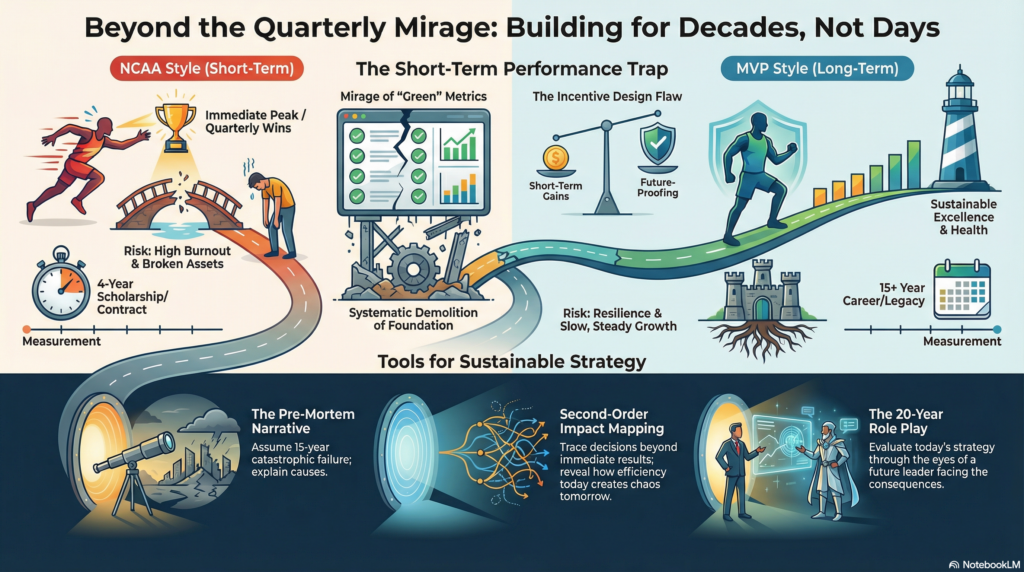
The Athletic Metaphor That Explains Everything

Want to see this pattern in pure form? Look at how different sports organizations develop talent.

Jamaica’s MVP Track Club has produced Olympic champions and world record holders whose careers span decades. Athletes like Shelly-Ann Fraser-Pryce and Elaine Thompson-Herah didn’t just win races—they sustained excellence well into their thirties, their bodies intact, their bank accounts healthy.

Meanwhile, the American collegiate athletics system—the NCAA—operates like a different species entirely. Talented high schoolers arrive with Olympic potential. Four years later, many flame out, never to compete internationally again. Bodies broken. Dreams abandoned.

Here’s what makes this fascinating: NCAA coaches aren’t incompetent. These are world-class professionals running billion-dollar programs with access to cutting-edge sports science. They track everything—times, splits, recovery metrics, nutrition, biomechanics.

Yet they’ve built a machine designed to extract maximum performance over four years, regardless of what happens afterward. The system optimizes perfectly—for conference championships, television contracts, recruitment rankings. And in the process, it systematically destroys the very athletes who make those outcomes possible.

MVP asked a different question entirely: What does success look like measured over a fifteen-year career instead of a four-year scholarship? The answer required sacrificing immediate gratification—forgoing certain meets, accepting slower progression, resisting the pressure to peak too early.

The NCAA doesn’t fail because its people are stupid. It fails because every incentive, every measurement, every reward structure points them toward short-term glory and long-term destruction. And every dashboard they monitor confirms they’re doing exactly what they’re supposed to do—right up until the athlete graduates broken.

Now here’s the uncomfortable question: Is your company running the NCAA playbook?

The Corporate Version of Athletic Destruction

Corporate history is littered with smart people making decisions that looked brilliant on every spreadsheet while quietly demolishing the foundation beneath them.

Consider the financial sector meltdowns of recent decades. Before the 2008 crisis, before Enron, before the savings and loan disasters of the 1980s, things looked spectacular. Quarterly earnings beat expectations. Risk models showed green lights. Executives earned accolades for innovative financial engineering.

The long-term destruction was being created from day one. Not by people too stupid to see it, but by systems designed never to look for it.

Why Intelligence Doesn’t Protect You

The trap works like this: The CEO who sacrifices this quarter’s numbers to protect next decade’s foundation doesn’t get applauded at the board meeting. They get questioned. Their judgment gets doubted. Their compensation takes a hit.

Meanwhile, the executive who delivers short-term wins—even by mortgaging the future—gets promoted, celebrated, interviewed by business publications.

This isn’t a failure of intelligence, discipline, or execution. It’s a design flaw in how success gets measured.

The answer isn’t working harder within the existing framework. It’s redesigning the framework itself. That requires confronting existential questions about what you’re actually optimizing for—and having the courage to challenge metrics that everyone agrees are “obviously” correct.

Three Techniques to Surface Hidden Disasters

Here are practical methods to force your leadership team to see beyond the quarterly mirage:

  1. The Pre-Mortem Exercise

Gather your strategy team. Give them one instruction: Assume your current initiative has failed catastrophically fifteen years from now. Write the detailed story of exactly how and why.

Not vague organizational hand-wringing like “we didn’t execute well enough.” A specific, uncomfortable narrative that traces the chain of consequences from today’s confident decision to tomorrow’s wreckage.

The discipline is in the specificity. “We lost market share” is useless. “We optimized our pricing algorithm for immediate margin expansion, which slowly trained our best customers to view us as a commodity, which eroded pricing power, which forced us into a desperate discount spiral that destroyed brand equity and made us vulnerable to a well-funded competitor who simply waited us out” is useful.

  1. The Second-Order Impact Map

Most strategy discussions evaluate immediate effects and stop there. “This restructuring reduces overhead by 18%.” Applause. Meeting adjourned.

The second-order map refuses to stop. It forces the room to keep pulling the thread: That cost reduction eliminates redundancy. Which reduces organizational resilience. Which means the next market shock hits harder. Which forces emergency measures. Which creates exactly the kind of chaos that drives your best people to competitors. Who use them to build what you should have built.

Keep pulling until the consequences become uncomfortable enough to reconsider the decision.

  1. The Twenty-Years-Later Role Play

Identify the youngest person in your leadership team. They become a time traveler.

It’s twenty years in the future. A new generation of leaders asks them: “What was it like in that 2026 strategy session? What did your team decide?”

They respond with two scenarios. First, the courage scenario: “We confronted the hardest questions. We acknowledged uncomfortable truths. We made decisions that hurt short-term but protected long-term. Here’s how it played out.”

Second, the cowardice scenario: “We pretended things we knew weren’t true. We optimized for looking good rather than being good. We told ourselves comfortable lies. Here’s the price we paid.”

The technique works because it makes abstract future consequences feel visceral and immediate.

The Choice That Defines Leadership

Every organization faces the same fundamental question: Are you building an MVP or running an NCAA program?

Are you optimizing for sustainable excellence or spectacular quarterly performance? Are you protecting the foundation or mining it for short-term gains?

The smartest people in the room will keep making the worst decisions until the room itself gets redesigned. Until the metrics change. Until the incentives shift. Until the questions being asked force long-term consequences into immediate view.

The techniques exist. The choice is whether you have the courage to use them.


P.S. Five Prompts for Deeper Reflection

Use these with your preferred AI to explore how these patterns might be operating in your specific context:

  1. “I’m a [your role] at a [your industry] company. We’re currently optimizing for [your key metric]. Help me identify what long-term value we might be destroying in the process. Be brutally specific about the chain of consequences I’m not seeing.”
  2. “Run a pre-mortem analysis: It’s 2040, and the strategy we implemented in 2025 has failed catastrophically. Write the detailed story of how our decision to [your current initiative] led to our downfall. Don’t hold back on uncomfortable specifics.”
  3. “I need a second-order impact map. Our first-order effect from [your decision] is [immediate outcome]. Help me trace at least five levels deeper into the consequences, particularly the ones that would take years to surface but would be devastating when they do.”
  4. “Create a dialogue between my 2025 self and my 2045 self. The older version has lived through the consequences of [current strategic choice]. What would they tell me that I’m not willing to hear right now?”
  5. “Analyze my industry through the NCAA vs MVP lens. Who in my competitive landscape is running the short-term optimization playbook? Who’s building for decades? What specific metrics distinguish them? What would it cost me to switch approaches?”

Strategic Fluency – Frameworks or Stories?

Transcript

00:00:01

Stop me if you’ve been in Bob’s position. Every strategist learns the frameworks. Porto five forces, blue ocean strategy, and SWAT analysis. And we assume great strategy comes from great frameworks. So how Schultz of Starbucks fame, he knew all of the frameworks, but he didn’t transform Starbucks or any of them. In 1983, Schulz visited Milan. He walked into an express bar. He saw the ritual, the community, the third place between home and work. And that experience became a story. That story became his northstar.

00:00:34

That story created a hundred billion dollar plus company. Not a framework, a story. But here’s where most strategists get stuck. Baba spent hours preparing for the strategy retreat. He had the perfect framework from his MBA and he was excited because he was going to nail it by explaining this framework. As the conversation progressed, some doubts crept in, but he prepared for hours. So when the moment came he jumped in and as he explained his framework eyes glazed over. So he tried to speed up

00:01:07

that made it worse. Phones came out people started to read and his boss gave him a dark look that was kind of like a cut it out and Bob gave up. But moments later another colleague jumped in. And in that case, she told a story. And Bob suddenly realized she was explaining the same concept that he just tried to describe using a framework. But this time, the heads were nodding. There were some new insights that were emerging as people built on her initial story. There was some buying happening. She was accomplishing the result. And he

00:01:42

thought to himself, why didn’t I try that? Well, here’s what he discovered and what Howard Schultz knew all along. that we’ve been taught that strategic thinking is about mastering frameworks. They give us the illusion of sophistication. But here’s the truth that plays out in every boardroom and every strategy retreat and every presentation given by consultants that there’s a big difference between strategic thinking and strategic fluency. Strategic thinking is all about those frameworks

00:02:09

that you learned in MBA school, ones I mentioned before. Strategic fluency teaches you stories. So when JFK committed America to go to the moon, he didn’t pull out the Gad chart. He didn’t tell a framework. Instead, he went to the future and told a story about the future. So the best strategists actually aren’t searching for which framework applies in which situation. Instead, they’re reaching out for their curated collection of signature stories. So how do you avoid that awkward moment Bob

00:02:38

found himself in? I recommend that you prepare three signature stories. One transformational stories like the one about Schulz in Milan. One about the future like Kennedy’s moonshot. And one story about strategic choice. That’s three stories. Good news is that Strat Cinema helps you to find your three.

This is a public episode. If you’d like to discuss this with other subscribers or get access to bonus episodes, visit longtermstrategy.substack.com/subscribe

The Strategy Handoff Crisis: Why Your Successor Can’t Think Like You Do

Companies obsess over documenting financial controls. They create detailed procedure manuals for operations. Yet when it comes to transferring strategic thinking between executives, most organizations fail spectacularly.

The problem isn’t a lack of documentation. It’s documenting the wrong things entirely.

The Six-Month Struggle Every Incoming Executive Faces

Here’s a scenario playing out in boardrooms worldwide: A seasoned executive departs. Their replacement inherits comprehensive transition materials—market analyses, strategic frameworks, financial models, implementation roadmaps, organizational diagrams, and risk assessments.

The incoming leader dedicates weeks to reviewing everything. They schedule meetings with key stakeholders. They take copious notes. They ask intelligent questions.

Six months later, they’re still struggling to make strategic calls with the confidence their predecessor demonstrated. They hesitate where the former leader acted decisively. They miss contextual nuances that seem obvious in hindsight.

What went wrong?

Nothing and everything. The documentation was thorough. The transition process followed best practices. But the handoff materials contained polished conclusions instead of strategic thinking itself.

This represents a fundamental misunderstanding about how strategic capability actually transfers between leaders.

What Your Transition Documents Are Actually Missing

Those transition binders look impressive. They contain everything a rational person would consider important: competitive threat assessments organized by market segment, positioning frameworks with detailed differentiation matrices, three-scenario financial projections, milestone-dependent implementation schedules, and comprehensive risk mitigation plans.

The critical gap? None of these materials explain how the organization arrived at its current strategic direction.

The genesis moment goes undocumented. Was the strategic pivot triggered by nearly losing a major client? Did a competitor’s unexpected move force a rethink? Did a board member ask an uncomfortable question that wouldn’t go away?

The discovery process remains invisible. What initial research contradicted long-held assumptions? Which sacred cows got sacrificed? When did the leadership team realize their comfortable worldview was dangerously wrong?

The human drama gets erased. That intense multi-day retreat where Finance and Operations clashed over resource priorities? Forgotten. The skeptical VP who opposed the initiative before becoming its most passionate advocate? Airbrushed out. The moment someone finally said what everyone was thinking but nobody wanted to acknowledge? Lost forever.

Most leadership teams justify these omissions with variations of: “That’s just internal politics. It’s unprofessional. The new executive needs our decisions, not our dirty laundry.”

This thinking is precisely backwards.

Why Messy Origin Stories Create Strategic Ownership

Consider two incoming executives facing the same strategic direction.

Executive A receives polished slide decks explaining the final strategic framework. Clean. Professional. Complete.

Executive B receives the full origin story: the triggering incident, the initial resistance, the data that changed minds, the fierce debates, the breakthrough moments, the implementation battles.

Three months later, both executives face pressure to abandon elements of the strategy. Market conditions have shifted. Key stakeholders are pushing for different priorities. Quick wins from alternative approaches look tempting.

Executive A, having only received conclusions, treats the strategy as inherited wisdom. They lack emotional investment. When challenged, they can recite the framework but can’t defend its foundations. They become susceptible to any argument that sounds reasonable because they never witnessed why alternative approaches were rejected.

Executive B, understanding the battle scars, responds differently. They know which assumptions were tested and survived. They understand which stakeholder concerns were addressed and how. They recognize which seductive alternatives were explicitly considered and rejected, and why. This knowledge creates conviction.

The messiness isn’t an embarrassing artifact to hide. It’s the mechanism that transforms a successor from a strategy executor into a strategy guardian.

Without origin stories, you’re handing someone a map without teaching them how to read terrain. They can follow the route you marked, but they can’t navigate when conditions change.

How Mental Models Beat Exhaustive Analysis

The second critical gap involves transferring strategic thinking patterns rather than strategic conclusions.

Your comprehensive transition documents provide analysis. What incoming executives actually need are the mental frameworks that generated that analysis.

Consider a healthcare organization undertaking strategic transformation. Traditional handoff approach: a 200-page document detailing market research, competitive positioning, customer segmentation, channel strategy, technology roadmap, and financial projections.

Alternative approach: “We’re becoming the Netflix of healthcare.”

That single sentence does more strategic work than 200 pages ever could. It instantly conveys: subscription relationships over transactional interactions, integrated digital experiences instead of fragmented touchpoints, platform thinking rather than service delivery, customer lifetime value over point-of-sale margins.

An incoming executive who internalizes this pattern can make hundreds of subsequent decisions aligned with strategic intent—without referring back to documentation. The pattern provides a mental model for evaluating new opportunities, prioritizing resources, and making trade-offs.

Analysis answers specific questions. Patterns teach strategic thinking.

Most transition documents fail here because outgoing executives don’t explicitly name the strategic patterns they’re using. These frameworks remain implicit—obvious to the departing leader but invisible to their successor.

Creating Genuine Strategic Urgency

The third missing element is the diagnostic story that explains why the current strategy became necessary.

Generic problem statements fill transition documents: “Market conditions are evolving.” “We need to maintain competitive advantage.” “Customer expectations are changing.”

These platitudes don’t create urgency. They create checkbox compliance.

Contrast that with a genuine diagnostic story: “Our analysis revealed we were Blockbuster in 2005. We had dominant market share, strong brand recognition, and profitable operations. We were also completely vulnerable. While we defended a dying business model, our industry’s Netflix equivalent was growing 40% annually. Our window for strategic response was roughly 18 months before our competitive position would become unrecoverable.”

That’s a diagnostic story with teeth. It explains why inaction represented an existential threat, not merely a missed opportunity. It creates urgency by making the stakes visceral and the timeline concrete.

Start Building Your Strategic Story Library Today

Most executives struggle to capture these three story types because they haven’t developed pattern recognition for what makes strategic stories effective. You need exposure to dozens of transformation cases before your mind identifies the underlying structures.

The solution? Deliberate practice with real business transformation narratives.

Start by studying how successful leaders explain their strategic pivots. Look for moments when executives describe “how we nearly missed this” or “why we became the [X] of our industry.” These moments contain the raw material for powerful strategic stories.

But finding quality transformation case studies scattered across YouTube and business media takes time—time most executives don’t have. That’s why platforms like StratCinema.org exist: to curate business transformation stories specifically for strategists developing this narrative fluency. Instead of algorithm-driven suggestions that keep you watching but not learning, you get carefully selected case studies that build pattern recognition.

Your next leadership transition deserves better than polished slide decks. It requires origin stories that create ownership, pattern stories that transfer mental models, and diagnostic stories that sustain urgency. Document these with the same rigor you apply to financial controls, and your successor won’t just execute your strategy—they’ll defend and evolve it.


P.S. Use AI to Capture Your Strategic Stories

Don’t have time to craft these stories from scratch? Modern AI tools can help you extract and structure the strategic narratives already in your head. Here are three sets of prompts—one for each story type—that you can use with any large language model to develop handoff materials that actually transfer strategic thinking.

Origin Story Prompts

“I need to document how our [specific strategic initiative] actually came together. Help me structure an origin story by asking me questions about: What triggered our initial concern? What was the ‘oh shit’ moment that made this urgent? Who were the initial skeptics and what convinced them? What data or insights contradicted our assumptions? What internal conflicts emerged during planning? Which alternatives did we seriously consider and reject? What breakthrough moment changed our approach? Walk me through these questions one at a time, then help me shape my answers into a compelling narrative that shows future leaders why this strategy emerged and what obstacles we overcame.”

Pattern Story Prompts

“Our strategy can be summarized as ‘[our approach]’ but I need to articulate the mental model behind it. Help me identify the pattern we’re following by asking: What successful company or strategy are we emulating? What’s our ‘[X] of [Y]’ statement? What core principle guides our decision-making? What trade-offs does this pattern naturally suggest? What does this pattern tell us to prioritize versus ignore? If someone internalized this pattern, what decisions would they make differently? Help me craft a concise pattern statement that transfers strategic intuition, not just strategic conclusions. Make it memorable enough that leaders can apply it without consulting documentation.”

Diagnostic Story Prompts

“I need to explain why our strategy was necessary—not just beneficial. Help me create a diagnostic story that conveys genuine urgency by asking: What complacent narrative were we telling ourselves before? What data revealed our vulnerability? What competitor or market shift threatened our position? What timeline were we facing? What would failure have looked like? What historical business failure does our situation resemble? Help me structure this into a narrative that makes inaction feel existential, not merely suboptimal. The goal is to transfer the visceral urgency we felt when we realized we had to transform.”

Ep 33 – From Laundry-list, Wishlist or Checklist to a Game-Changing Strategy

Picture two teams in your company, six months apart.

The first team is drowning. They have 47 “strategic initiatives” on their list, no clear way to prioritize, and every meeting devolves into debates about resources. Morale is terrible, and nobody can articulate what they’re really trying to accomplish.

Fast forward six months: the same team, but now they’re energized, focused, and can explain their strategy in three minutes. Projects that don’t serve their core hypothesis get killed quickly. They’re making contingency plans because they understand their strategy is a bet, not a certainty.

What happened in between?

They stopped confusing a strategic plan with actual strategy. Today, I want to walk you through that transformation, because the gap between these two states isn’t about working harder—it’s about thinking differently.

Tune into this episode to join me in tackling this wicked problem.

I’m Francis Wade and welcome to the JumpLeap Long-Term Strategy Podcast

Here is a video of the full episode. You can also follow the podcast on YouTube.

Show Notes

NotebookLM link

https://notebooklm.google.com/notebook/6e0f6686-25ff-44b8-a629-54df92dbef7c?authuser=1

Link to Fictional Credit Union Case

https://notebooklm.google.com/notebook/33364888-4e5a-4738-80d1-24f2c42c66cd?authuser=1

Roger Martin’s Video

This is a public episode. If you’d like to discuss this with other subscribers or get access to bonus episodes, visit longtermstrategy.substack.com/subscribe

Ep 33 – From Laundry-list, Wishlist or Checklist to a Game-Changing Strategy

Picture two teams in your company, six months apart.

The first team is drowning. They have 47 “strategic initiatives” on their list, no clear way to prioritize, and every meeting devolves into debates about resources. Morale is terrible, and nobody can articulate what they’re really trying to accomplish.

Fast forward six months: the same team, but now they’re energized, focused, and can explain their strategy in three minutes. Projects that don’t serve their core hypothesis get killed quickly. They’re making contingency plans because they understand their strategy is a bet, not a certainty.

What happened in between?

They stopped confusing a strategic plan with actual strategy. Today, I want to walk you through that transformation, because the gap between these two states isn’t about working harder—it’s about thinking differently.

Tune into this episode to join me in tackling this wicked problem.

I’m Francis Wade and welcome to the JumpLeap Long-Term Strategy Podcast

Here is a video of the full episode. You can also follow the podcast on YouTube.

Show Notes

NotebookLM link

https://notebooklm.google.com/notebook/6e0f6686-25ff-44b8-a629-54df92dbef7c?authuser=1

Link to Fictional Credit Union Case

https://notebooklm.google.com/notebook/33364888-4e5a-4738-80d1-24f2c42c66cd?authuser=1

Roger Martin’s Video

This is a public episode. If you’d like to discuss this with other subscribers or get access to bonus episodes, visit longtermstrategy.substack.com/subscribe

Ep 33 – From Laundry-list, Wishlist or Checklist to a Game-Changing Strategy

Picture two teams in your company, six months apart.

The first team is drowning. They have 47 “strategic initiatives” on their list, no clear way to prioritize, and every meeting devolves into debates about resources. Morale is terrible, and nobody can articulate what they’re really trying to accomplish.

Fast forward six months: the same team, but now they’re energized, focused, and can explain their strategy in three minutes. Projects that don’t serve their core hypothesis get killed quickly. They’re making contingency plans because they understand their strategy is a bet, not a certainty.

What happened in between?

They stopped confusing a strategic plan with actual strategy. Today, I want to walk you through that transformation, because the gap between these two states isn’t about working harder—it’s about thinking differently.

Tune into this episode to join me in tackling this wicked problem.

I’m Francis Wade and welcome to the JumpLeap Long-Term Strategy Podcast

Here is a video of the full episode. You can also follow the podcast on YouTube.

Show Notes

NotebookLM link

https://notebooklm.google.com/notebook/6e0f6686-25ff-44b8-a629-54df92dbef7c?authuser=1

Link to Fictional Credit Union Case

https://notebooklm.google.com/notebook/33364888-4e5a-4738-80d1-24f2c42c66cd?authuser=1

Roger Martin’s Video

This is a public episode. If you’d like to discuss this with other subscribers or get access to bonus episodes, visit longtermstrategy.substack.com/subscribe