
Three Horizons for Strategic Thinking: A Guide for Long-Term Planning Advocates

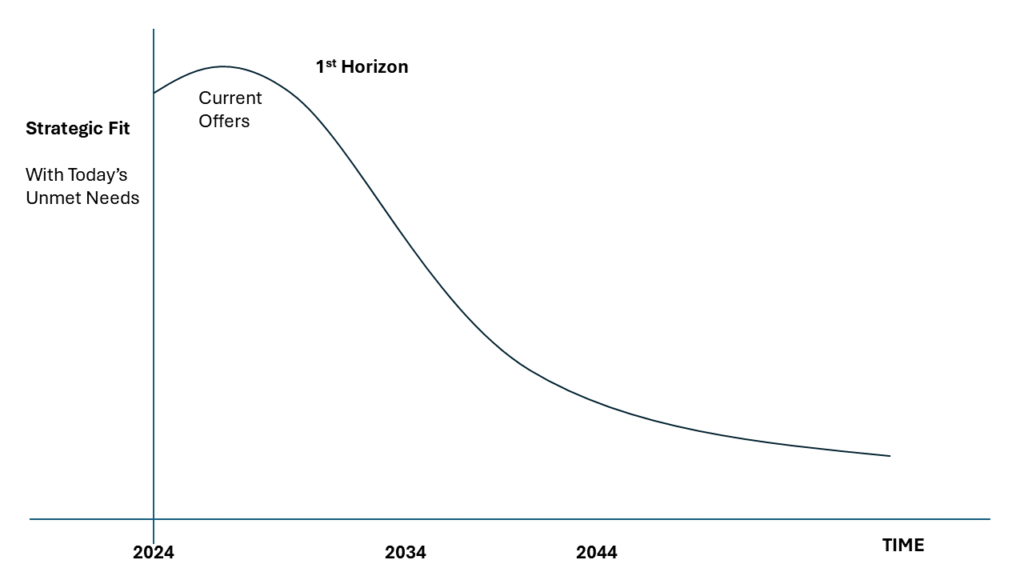
As a proponent of long-term thinking in your company, you’ve likely encountered resistance. You may feel isolated, struggling to articulate the value of strategic foresight to colleagues focused on immediate concerns. This guide aims to provide you with a framework to effectively communicate the importance of long-term strategic planning (LTSP) and engage others in this crucial mindset. The Challenge of Long-Term Thinking You’ve probably experienced this scenario: In a meeting, you highlight a future your colleagues can’t see. The potential long-term consequences seem obvious to you. Unfortunately, your team, preoccupied with urgent problems, lacks the energy to consider your strategic viewpoint. They opt for the quick satisfaction of immediate resolutions. Afterwards, you realize that fundamental issues remain unaddressed. It feels like you’re only discussing surface-level solutions without questioning the underlying approach. If this resonates with you, you’re not alone. Many forward-thinking professionals struggle to convey the importance of LTSP. But there’s a way to bridge this gap and bring others into long-term thinking: the Three Horizons Framework by Curry, Hodgson and Sharpe. Horizon 1: Understanding the Decay of Current Offerings Every organization provides value through its products or services. However, it’s crucial to recognize that these offerings have a limited lifespan. Each day brings you closer to the point where your current solutions become obsolete. Consider the photography industry. Until the 2000s, companies like Kodak and Fuji thrived selling film. Today, the average consumer has no interest in this product. This decay in demand is a universal truth in business, illustrated by the following curve:
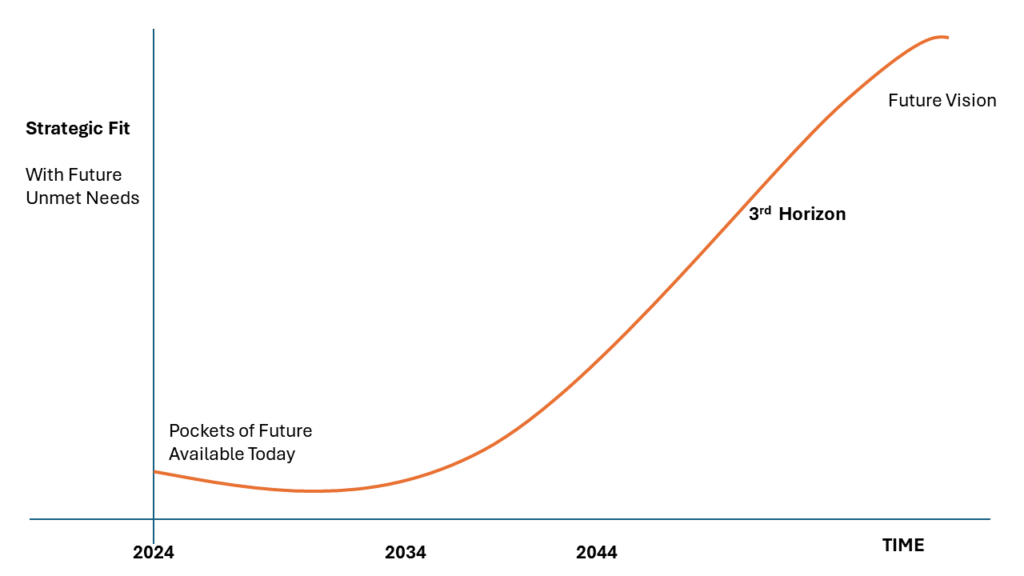
The key question is: How long will your current strategic fit last? As an LTSP advocate, you’ve likely considered this. Now, you have a visual representation to share with your colleagues, helping them grasp this concept more easily. Horizon 3: Recognizing Future Opportunities While managing current operations is crucial, it’s equally important to look for signs of future trends. These “faint signals” can be found in emerging technologies, evolving customer needs, new regulations, environmental changes, and various other areas. By paying attention to these signals, your team can craft narratives about potential futures. This foresight defines the third horizon:
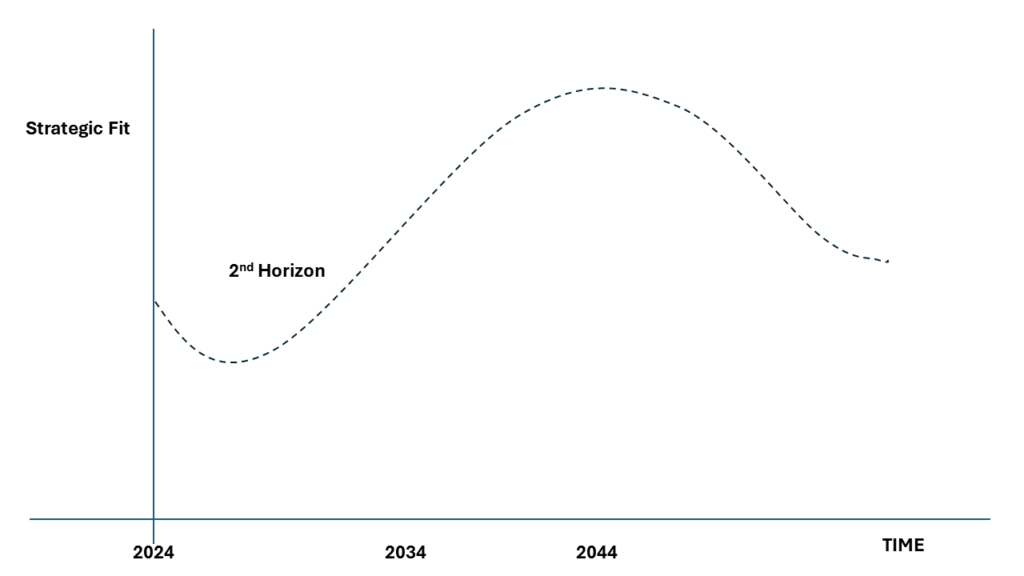
Many companies overlook these disruptors by failing to plan far enough ahead. As an LTSP proponent, you can encourage your team to do more than passively observe these changes. Instead, position your organization to influence and shape these future scenarios. Horizon 2: Bridging Present and Future To transition from current offerings to future opportunities, your organization needs a bridge – this is Horizon 2:
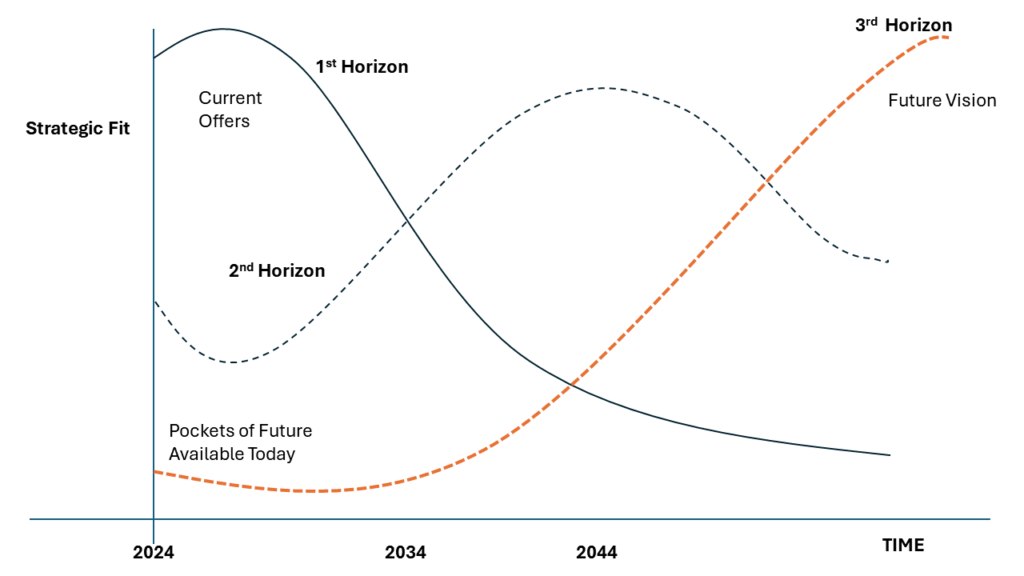
These are initiatives that may not represent your ultimate vision but serve as stepping stones towards it. Developing these transition strategies is best done in strategic planning retreats, where all departments can contribute their insights. Integrating the Three Horizons When effectively implemented, the Three Horizons Framework allows your organization to manage current operations, develop transition strategies, and prepare for future scenarios simultaneously:
This integrated approach demonstrates how long-term imperatives can and should inform immediate actions. Conclusion: Empowering Long-Term Strategic Planning By using the Three Horizons Framework, you now have a powerful tool to illustrate the importance of long-term thinking to your colleagues. This approach allows you to: 1. Visually represent the lifecycle of current offerings 2. Highlight the importance of future-focused initiatives 3. Demonstrate how to bridge present operations with future opportunities 4. Show how all these elements work together in a cohesive strategy Remember, you’re not alone in advocating for LTSP. Many successful organizations embrace this approach, recognizing that preparation for the future is key to long-term success. Use this framework to spark meaningful discussions about your company’s future. By doing so, you’re not just planning for tomorrow – you’re shaping it. Or learn more about the LeapOut approach and the detailed strategic planning framework we use with our clients.

Ep 18 – When a Written Strategy Document Lacks a Strategy

This is a free preview of a paid episode. To hear more, visit longtermstrategy.substack.com

Your company has a long history of putting together strategic plans. And you have diligently read them all in a search to understand the intentions of prior leaders.

But as you look them over you are concerned. There are lots of todo lists, action items, and budgets, but the underlying plan seems to lack something important – a strategy.

You can’t quite explain why this is the case, but you can tell when that intangible quality is missing. Perhaps, there should be a better way to tell than just raw instinct, but how?

Tune into this episode to hear from me and my special guest, Alexis Savkin, as we solve this wicked problem together.  You can access more of his articles on strategic planning at https://bscdesigner.com.

If you are a free subscriber, you can view the excerpt below. Upgrade your membership today for full and instant access to all past and future episodes.

Subscribers. here is the full video.

Ep 18 – When a Written Strategy Document Lacks a Strategy

This is a free preview of a paid episode. To hear more, visit longtermstrategy.substack.com

Your company has a long history of putting together strategic plans. And you have diligently read them all in a search to understand the intentions of prior leaders.

But as you look them over you are concerned. There are lots of todo lists, action items, and budgets, but the underlying plan seems to lack something important – a strategy.

You can’t quite explain why this is the case, but you can tell when that intangible quality is missing. Perhaps, there should be a better way to tell than just raw instinct, but how?

Tune into this episode to hear from me and my special guest, Alexis Savkin, as we solve this wicked problem together.  You can access more of his articles on strategic planning at https://bscdesigner.com.

If you are a free subscriber, you can view the excerpt below. Upgrade your membership today for full and instant access to all past and future episodes.

Subscribers. here is the full video.

Ep 17 – How to Find Time for Strategic Planning

You are in charge of implementing your company’s new strategic plan. It includes some brilliant new ideas which should shake up your industry, and even introduce the world to a new category of products and services.

But you are a bit wary because prior strategic plans barely made it off the PowerPoint pages. They weren’t implemented due to a common complaint – no-one had the time.

You have every reason to be worried, but what should you do about the problem?

Tune into this episode to join me in tackling this wicked problem from two perspectives at once…task management and strategic planning.

I’m Francis Wade and welcome to the Task Management & Time Blocking Podcast and the JumpLeap Long-Term Strategy Podcast.

This is a public episode. If you’d like to discuss this with other subscribers or get access to bonus episodes, visit longtermstrategy.substack.com/subscribe

Strategy for Jamaican Sports Federations

You love your national sport. Seeing the Jamaican (or West Indian) flag soar above a global stage fires you up. But you also see that in football and cricket, we’ve fallen as a country. Could it be related to a lack of long-term thinking? When the West Indies men’s cricket team dominated the world in the 1980s and 90s, other countries envied them. They all tried to catch up, but Australia’s response was unique. They decided to invest in youth cricket like never before. Why? They recognized a long-term problem. Quick fixes wouldn’t solve it permanently. Fast forward a decade, and their success since then shows their planning at work. While we in the West Indies struggle to find talent, revive interest, and fix governance problems, Australian dominance continues. Simply put, they built a system to win international cricket. Meanwhile, the West Indies continues to fail, except for occasional successes. We get lucky sometimes and win, but those wins happen despite our system, not because of it. I’m not criticizing our setup; I’m not an expert. But if we learn from Australia’s long-term focus, can we apply it to our national football team? We Jamaicans got lucky and competed in the World Cup once, but a sustainable system is still missing there. More importantly, is there something our sporting federations can do differently in their planning? Here are three ideas if you’re part of one. 1. Pick a Target Year and Visualize First, set a planning horizon 10-30 years ahead, and name it your Target Year. Be careful; picking too close or too far has downsides. If you pick a year too close, it becomes selfish. You’ll be pushing aside future generations. Also, if you’re too aggressive with your short-term goals, others won’t believe you. As a result, they won’t take action. On the other hand, if you pick a year too far away, your plan could become irrelevant as soon as its developed. There won’t be enough urgency for stakeholders to respond. But the key is not just choosing the right year. The idea is to commit to milestones between now and your target date. These milestones should create the right mindset on a large scale. They should inspire people of all ages to make the sacrifices needed for world-class performance. After setting a Target Year, create a vivid vision or end-game. This isn’t just a vague “vision statement” but a numeric, measurable list of outcomes. Together, they describe your desired future. Within this space, generate up to three unique but alternative visions. Then, choose one. Many organizations make a big mistake by stopping here. 2. Strategize Backwards To connect your vision to reality, you need to backcast, or plan backward from your desired future to the present. As you do, you’ll correct two common anomalies. The first anomaly is that some of your initial, visionary outcomes are probably unrealistic, and some will be overly ambitious. The second anomaly is when the Target Year itself has to change to make the plan work. Don’t remove these anomalies randomly. Your team needs to find a careful balance between aspirations and reality. As such, this is a task for insiders and can’t be outsourced. If your team fails to achieve this balance, you’ll lose fan support. For example, if they sense that the planning team said yes to too many things without making tough choices, they may turn away. Your plan needs to make logical sense. 3. Build Social Support Sporting federations need widespread fan support, but the old way of “selling” your plan to people doesn’t work anymore. Instead, the modern approach is to involve fans in the process from the beginning. But this doesn’t mean filling a room with hundreds at every meeting. The key is to incorporate both divergent and convergent activities in your schedule. Divergent activities are invitations to gather more input. They benefit from broad participation. However, convergent activities involve making tough decisions using that same input. This is a consolidation step where you summarize and draw conclusions. Use both in a sort of dance, and you’ll bring your fans into your long-term thinking and the planning needed to achieve success in your sport.
Find out more regarding the LeapOut approach and the detailed strategic planning framework we use with our clients.